The World In Africa

997056_10152655312289060_9142383484974150854_n

Boggles the mind both for size and for all the geo-political and historical implications. Especially considering how many people still think of Africa in some fuzzy way as a “country,” if and when they think of it at all.

Illustrations: The Economist

Speaking At A Vigil: Black Lives Matter

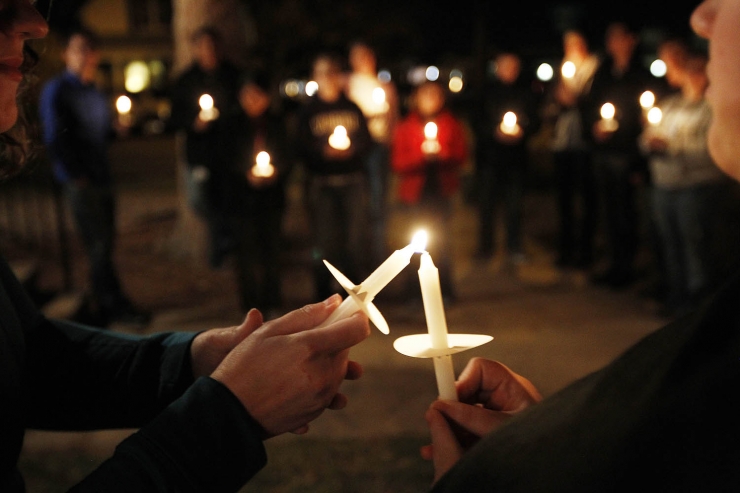
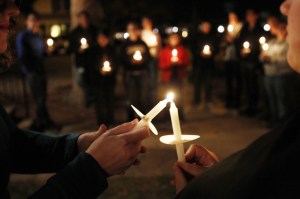
1022111_Candlelight_Vigil_1_AC(pp_w740_h493)I was honored to be invited to be one of the speakers at the candlelight vigil in our town square last month. These are my remarks.

***

VIGIL 12/14/14

 Michael Brown was a flawed, teenaged, knucklehead, who had been shortchanged growing up by lousy schools, and limited horizons. He committed a stupid and bullying act. And according to far too many people, who he was and what he did equaled a capital offense. One which justified not only shooting him down in the street, but leaving his body there unattended for 4 ½ hours in the heat of August. In America. While the police officer who shot him went into hiding without even filing a report.

And when we turned our eyes away from those photographs of an 18 year old, dead in the street, we found ourselves seeing over and over again video of Eric Garner, overpowered, brought down, his head and torso forced to the sidewalk, his pleas ignored, and EMT care flagrantly, callously, denied him. And he died there, on the sidewalk. In America.
1505243_10202367105897445_8885975353488264834_n

And as we exclaimed over that video, another appeared. Tamir Rice, a 12-year-old boy playing alone in a park on a chilly day; a bit bored, a bit lost in his own thoughts of derring-do, playing with his toy gun. We see a police car surprise him and two seconds, two seconds later, he is dying on the ground. And the officers in the car did not go to his aid. And they said they had warned him three times to put down that gun. That was before they knew they had been videotaped.

And Akai Gurley walking down the stairs in the building where he lived in New York City, shot dead by police in a dark hallway. The officers called their union rep. while the man died, and before they called for assistance.

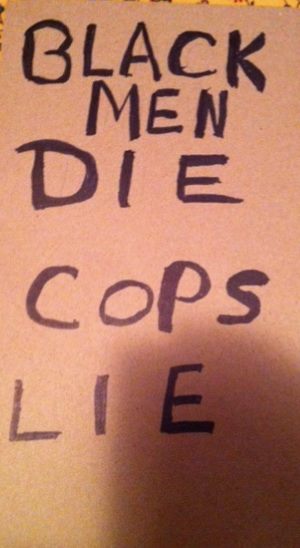
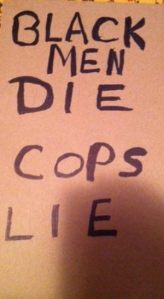
What those who died had in common was being black, and male. In America.
1920426_10202367106657464_2818586075458377860_n

But I don’t have to tell you about those outrages. We are the choir. We’re out here in this cold because we are the choir. So what would I, a fellow member, ask of the choir? Three things.

First, talk about it. We all have to sort out our thoughts on what is happening. On the culture of American law enforcement that closes ranks in support of bad apples and makes it too great a risk for good men and women in departments to speak out against police malfeasance. Gather information, current and historical, and do the work of thinking this through. Not alone, not in isolation; conversations, certainly. The way of change, worldwide, going forward, will involve the widest possible conversations by way of social media.

So talk with people you know. Yes, those vaunted conversions on race – so often honored in the breach. There are many reasons why staged interracial conversations often fizzle out, including the inevitable imbalance between ongoing experience on one side and intermittent curiosity on the other.

So how about you white folks talk to each other? That’s hard, too. But it is crucial to have conversations about these matters that don’t end when each party gets into a car and they drive home in opposite directions, to become strangers again.

Second, act locally. One case in point: do our part to make sure that here as across the country, every police officer’s basic equipment includes a body camera. That every police vehicle is equipped with a dashboard camera. Racist violence happens throughout our society. But what has brought us here tonight is the nature of the interaction between predominantly white American police forces, and unarmed black men, women, and children.

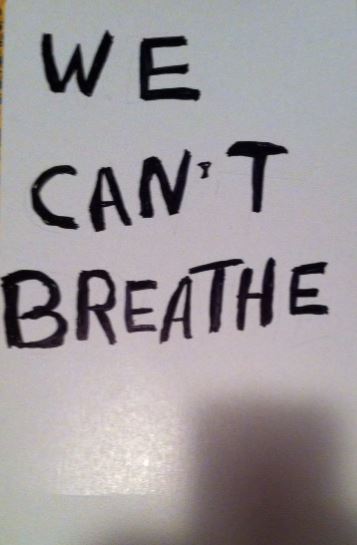
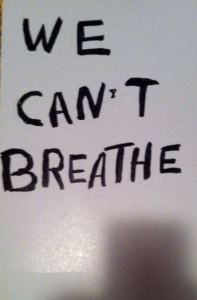
And the third, and final thing I’ll say is that we all must hold at least one thing in clear focus as we think, talk, demonstrate, and that is one word, one demand, one outcome. Accountability. That those who wield the power and the weapons stand genuinely accountable to the communities they police. That’s not the only thing we want, change is difficult and multi-layered, but we must insist upon that fundamental thing, unbiased, transparent, official accountability. Without it, justice cannot breathe.
images

Photo credit: A Race Together
About That Paris March…

HEADSOkay, I’m feeling dense here. The massacre at Charlie Hebdo was an act of fundamentalist religious madness with an undeniable political dimension that makes it all the more horrendous as a potential goad to other criminal and/or deranged extremists who see it as an acceptable act of revenge for insults to Islam

The simultaneous attack on the kosher market was another facet of religio-fascist Islamic fanaticism that considers Jews a particularly heinous subset of infidels.

I understand the spontaneous gatherings of the thousands who poured out into the streets of Paris. My older son was among them. In the midst of such trauma and uncertainty (the killers were still on the loose; the shoppers in the market were being held hostage) such an act of community, solidarity, and mourning is a good, positive response.

I understand the immediate messages to the French nation of concern and condolence from world leaders and prominent international figures.

What I don’t really get, as I think about it, is the meaning of all those dignitaries and heads of state, many of of them, as has been pointed out, among the cruelest dictators on the planet, some of the most repressive national leaders, who, even as they march in Paris, hold journalists, dissenters, political rivals, etc. in brutal captivity. Who torture, exile, spy on, and silence their own people on merely the suspicion of dissenting ideas.

What, exactly, is the message of this outpouring of the notable and the just plain folk? Why do I feel this is one big anti-Islamic gesture that will further marginalize millions of men, women, and children resident in western nations, and give license to the demonization of Muslims worldwide? I just don’t see this cadre of “world leaders” dropping everything to go stand up and be counted for Liberty, Equality, and Fraternity, or for freedom of the press, or for… what, exactly?

https://storify.com/tometty/staunch-defenders-of-free-press-attend-solidarity

a-muslim-girl-joins-in-solidarity-with-the-crowds-at-the-march

HEBDO

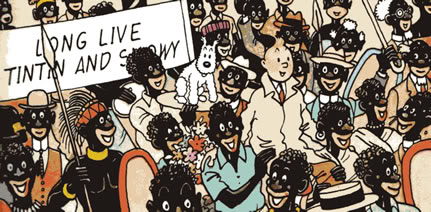
tintin-in-the-congoNot going all up into it just now. Murder is murder, and we owe respect and a decent interval to the deceased.

However, I’m saying that I have long had issues with French, and some other European, free- for-all-let-it-rip racist humor. I assume the black and Arab caricatures are rooted in colonialism. The anti-Semitism is home-grown.

The steady background presence of casual racism from Tintin (ok, Belgian, but big in French nurseries) to all sorts of ads (Y’a Bon, of my youth, hung in until 2006, I see) and cartoons, political and otherwise, is too easily dismissed as freedom of whatever with no accountability for content. 004990396

Of course they should be free to publish whatever they want, but don’t pretend that repetitious racist schlock is sharp-edged political discourse or subversive satire.

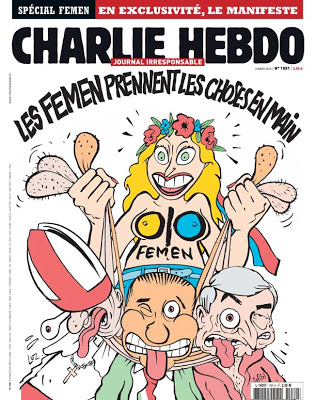
Charlie Hebdo should keep going as a matter of free speech; once in a while they even make a clever point (“It’s so depressing to be worshiped by idiots” says Mohammad). But look at those same graphics and imagine them from the LePen camp. Maybe some of the anti-Catholic stuff wouldn’t fly there, but much of the rest would be right at home. How is all that racist, sexist, homophobic, anti-Semitic juvenilia supposedly brimming with political or social insight? Yes, there’s really vicious stuff from right wing publications, but it’s not always easy to tell the difference…  FEMEN charlie hebdo

So Josephine Baker’s bananas make me wince, but she made up for it by risking her life during the War.

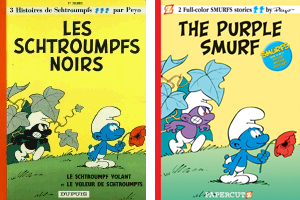
BlackPurpleSmurf-1

Hard To “Plan” For Some Encounters With Police

Walking-while-Black---Is-NOT-a-CRIME!-T-ShirtsSomething that doesn’t gets discussed. There’s appropriate emphasis on “the talk” with black youngsters, and telling black people in general how to act when they are stopped by police. What is not factored in is the sense of total surprise and world turned upside down of minding your business one second and being treated as a crime suspect the next that frequently happens to well-dressed, respectable, pillar-of-community black folks going about their business who are suddenly stopped on the street and told they “resemble” the description of someone who just committed some major crime. Never mind the often 20 years, 40 pounds, and 6 inches of height difference between the perp and the person stopped.

It takes an inordinate amount of presence of mind to really deal calmly with a situation where you have to wonder what someone crazy enough to stop you with that rationale is in fact likely to do next. The disconnect is so great that it’s as if you are standing there facing a police officer who has gone completely off his rocker.

The visceral response is to get distance between yourself and someone with a gun who is babbling incoherent nonsense about you possibly having just robbed a bank or something of the sort. It’s one thing to plan to be polite, respectful, follow instructions, not talk back. But in reality, how could you possibly not be overcome by initial confusion, ask questions, or say something?

I’m not talking about Michael Brown or Eric Garner, here, but the hundreds of thousands of black men and women, or worst of all, teenagers, who are caught totally off guard. Who, in their right mind (outside of daily life in a ghetto ‘hood, sadly), plans on or even rehearses for being stopped in their tracks in that way during an ordinary business or school day? And the police know that and often take advantage of that confusion to claim resistance and escalate the encounter.

canstock18772036

A Few Notes On Seeing Kara Walker Speak

KW1Kara Walker was wonderful. So glad I went. Certainly the art must stand apart from the artist, but given all the flap about her earlier cut paper work, it made such a difference to hear from the woman behind it all. And then to move on to hear about the Domino Sugar Factory project.

She was informal, conversational, witty, incredibly well/broadly read, brilliant in ways that make sparks fly as you listen to her. Profoundly rooted in her work and not just willing, but able, in ways not all visual artists necessarily are, to talk about her process in all its determination, uncertainty, exhilaration, intention, association. In part, what she called her ” chutzpah, bravado, and ego,” in accepting the Domino project, which she first refused, with no idea of what she would do.

She talked from a few note cards rather than giving a lecture, thank goodness. Complete with pauses, chuckles at herself, more than one ref. to the act of “riffing” as part of the drawing and writing that leads to formulating ideas, and a noble throw away line that “People don’t want to see art that reminds them how fucked-up they are” although that doesn’t stop her from producing it.

Turns out the Sphinx was her first work of sculpture — ever. She did incredible research on sugar, molasses, blacks and sugar production, popular imagery about blacks and sugar. Also sugar as a European delicacy, compared to say, honey, which was around much longer and how sugar had a different cultural/ social meaning, being a kind of primal “sweet salt.”

Huge team of craftspeople to construct the exhibition. She showed a few minutes of a couple of videos, one that looked at audience response. The one of workers creating the sphinx had a monumental fast-time feel that was startling — like watching Egyptians work with blocks of ancient stone. And the stories of trying to cast the standing boys in sugar… And saying the abandoned factory was a kind of cathedral.

Video of the work being dismantled, the sphinx “had a kind of generosity about her,” in terms of reverent and irreverent audience response.

Controversy seemed in the past, she has moved on to thinking about many other projects, but she talked about how she came to that work initially, partly as trying to break out of the grand painting tradition. The cut paper images were a popular 19th-cent. form and allowed racial and social commentary. One question touched on controversy and how she decided to not be nice. She said, laughing, “I never stopped trying to be nice. I just realized I wasn’t.”

Black Life Not Worth The Proverbial Indictable Ham Sandwich

imagesThese cases are not about what commentators and pundits keep saying they are about. Think for a moment about who joins police forces. There is a direct line from birtherism, Muslim President, Don’t Tread on Me, etc. to shooting a 12 year old dead at point blank range. 

These deaths, and others that we don’t even know about, are ways of saying not only will most white men never respect any black man as President, these officers, sworn to protect and defend, are making it clear that black men’s lives have little value and they can kill them with total impunity.

It might be ironic, but, because these Tea-Party-in-uniform types keep pushing to the extremes, Obama will likely end up being a human/civil rights president in spite of himself.

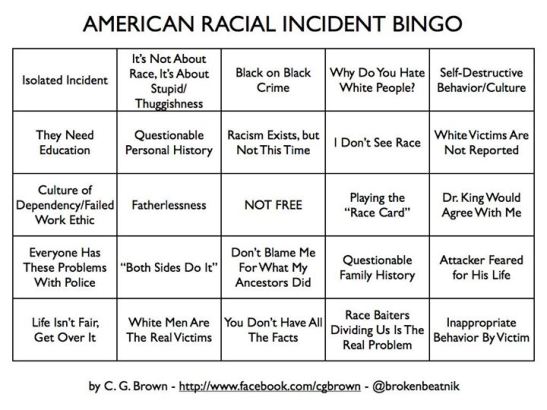
BINGO!

Up, down, or across, each one nails it.

905525_10152894786907288_258496331112787388_o