

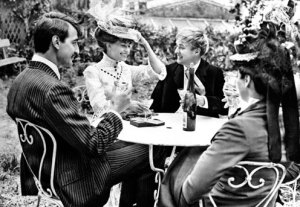


. . . and your favorite film is?
http://www.youtube.com/watch?v=dcVcwwo8QFE
<<<<<<<<<<<<<<<>>>>>>>>>>>>>>>
DAN BERING PHOTOS

. . . MONTMARTRE

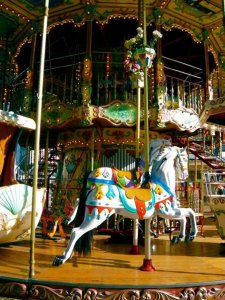
. . . and your favorite film is?
http://www.youtube.com/watch?v=dcVcwwo8QFE
<<<<<<<<<<<<<<<>>>>>>>>>>>>>>>
DAN BERING PHOTOS
. . . MONTMARTRE
Posted in artandhistory, Jules et Jim
—————————————————
BON Restaurant, Paris
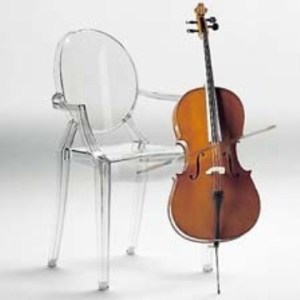
Patricia Wells had a hissy fit about the place when it first opened, but apparently things have changed. On a Friday night we had a pleasant welcome even without a recommended reservation; enjoyed the decor (I’m a fan of Starck’s ghost chairs) excellent service and suggestions, and a delicious dinner. Only odd element was yet another tin-eared French take on American pop as background music, but the mix of rap, rock, ballads and blues was just silly, not really annoying.
—————————————————————————-
Another photo by Dan Bering


Che Guevara and Fidel Castro
“Revolution is a moment”
– Jane McManus


I’m always ready to go back and see more. There are things to admire, things to question, and I certainly wish the racial situation were better.
______________________________________________________________________________
HAVANA, NEW YORK, PARIS . . .unsettled thoughts
Paris vs. Havana
By Roger Cohen
NYTimes online op-ed
December 8, 2008
Since visiting Cuba a few weeks ago, I’ve been thinking about the visual assault on our lives. Climb in a New York taxi these days and a TV comes on with its bombardment of news and ads. It’s become passé to gaze out the window, watch the sunlight on a wall, a child’s smile, the city breathing.
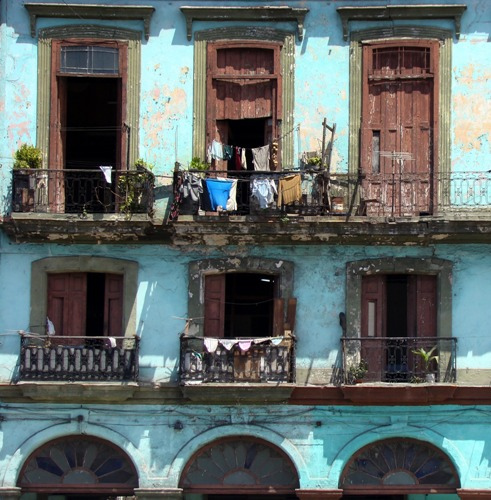
In Havana, I’d spend long hours contemplating a single street. Nothing — not a brand, an advertisement or a neon sign — distracted me from the city’s sunlit surrender to time passing. At a colossal price, Fidel Castro’s pursuit of socialism has forged a unique aesthetic, freed from agitation, caught in a haunting equilibrium of stillness and decay.
Such empty spaces, away from the assault of marketing, beyond every form of message (e-mail, text, twitter), erode in the modern world, to the point that silence provokes a why-am-I-not-in-demand anxiety. Technology induces ever more subtle forms of addiction, to products, but also to agitation itself. The global mall reproduces itself, its bright and air-conditioned sterility extinguishing every distinctive germ.
Paris, of course, has resisted homogenization. It’s still Paris, with its strong Haussmannian arteries, its parks of satisfying geometry, its islands pointing their prows toward the solemn bridges, its gilt and gravel, its zinc-roofed maids’ rooms arrayed atop the city as if deposited by some magician who stole in at night.
It’s still a place where temptation exists only to be yielded to and where time stops to guard forever an image in the heart. All young lovers should have a row in the Tuileries in order to make up on the Pont Neuf.
Yet, for all its enduring seductiveness, Paris has ceased to be the city that I knew. The modern world has sucked out some essence, leaving a film-set perfection hollowed out behind the five-story facades. The past has been anaesthetized. It has been packaged. It now seems less a part of the city’s fabric than it is a kitschy gimmick as easily reproduced as a Lautrec poster.
I know, in middle age the business of life is less about doing things for the first than for the last time. It is easy to feel a twinge of regret. Those briny oysters, the glistening mackerel on their bed of ice at the Rue Mouffetard, the drowsy emptied city in August, the unctuousness of a Beef Bourguignon: these things can be experienced for the first time only once.
So what I experience in Paris is less what is before me than the memory it provokes of the city in 1975. Memories, as Apollinaire noted, are like the sound of hunters’ horns fading in the wind. Still, they linger. The town looks much the same, if prettified. What has changed has changed from within.
At dinner with people I’d known back then, I was grappling with this elusive feeling when my friend lit a match. It was a Russian match acquired in Belgrade and so did not conform to current European Union nanny-state standards. The flame jumped. The sulfur whiff was pungent. A real match!
Then it came to me: what Paris had lost to modernity was its pungency. Gone was the acrid Gitane-Gauloise pall of any self-respecting café. Gone was the garlic whiff of the early-morning Metro to the Place d’Italie. Gone were the mineral mid-morning Sauvignons Blancs downed bar-side by red-eyed men.
Gone were the horse butchers and the tripe restaurants in the 12th arrondissement. Gone (replaced by bad English) was the laconic snarl of Parisian greeting. Gone were the bad teeth, the yellowing moustaches, the hammering of artisans, the middle-aged prostitutes in doorways, the seat-less toilets on the stairs, and an entire group of people called the working class.
Gone, in short, was Paris in the glory of its squalor, in the time before anyone thought a Frenchman would accept a sandwich for lunch, or decreed that the great unwashed should inhabit the distant suburbs. The city has been sanitized.
But squalor connects. When you clean, when you favor hermetic sealing in the name of safety, you also disconnect people from one another. When on top of that you add layers of solipsistic technology, the isolation intensifies. In its preserved Gallic disguise, Paris is today no less a globalized city than New York.
Havana has also preserved its architecture — the wrought-iron balconies, the caryatids, the baroque flourishes — even if it is crumbling. What has been preserved with it, thanks to socialist economic disaster, is that very pungent texture Paris has lost to modernity.
The slugs of Havana Club rum in bars lit by fluorescent light, the dominos banged on street tables, the raucous conversations in high doorways, the whiff of puros, the beat through bad speakers of drums and maracas, the idle sensuality of Blackberry-free days: Cuba took me back decades to an era when time did not always demand to be put to use.
I thought I’d always have Paris. But Havana helped me see, by the flare of a Russian match, that mine is gone.
<<<<<<<<<>>>>>>>>>>
<<<<<<<<<>>>>>>>>>

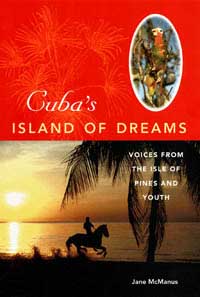
Two books by my late friend, Jane, McManus, who lived in Havana
 Sold at Sotheby’s New York, 22 May 2008
EDMONIA LEWIS
(CIRCA 1843- 1907)
THE OLD ARROW MAKER
Estimate: 70,000—100,000 USD
Lot Sold. Hammer Price with Buyer’s Premium: 301,000 USD
Marilyn Richardson’s letter confirming the sculpture’s authenticity will accompany the lot.
CATALOGUE NOTE
Marilyn Richardson writes: “Along with income from sales and commissions, Edmonia Lewis supported herself through the sale of marble busts and groups illustrating scenes from Henry Wadsworth Longfellow’s phenomenal bestseller, the epic poem The Song of Hiawatha (1855). While inumberable painters and sculptors drew inspiration from that poem, Lewis’s figures were particular favorites among collectors, created as they were by the hand of a woman known to be part Ojibway.
“Copies of The Old Arrow Maker (sometimes called The Old Arrow Maker and His Daughter) identical in design and composition, were also titled The Wooing of Hiawatha. Both titles come from Longfellow’s Chapter X, “Hiawatha’s Wooing,” which includes the passages:
At the doorway of his wigwam
Sat the ancient Arrow-Maker…
Making arrowheads of jasper …
At his side, in all her beauty,
Sat the lovely Minnehaha …
Plaiting mats of flags and rushes; …
And further along:
At the feet of Laughing Water
Hiawatha laid his burden,
Threw the red deer from his shoulders;…
Posted in 19th century, Edmonia Lewis

“Bristling innovation and mainstream melody-making classical modernism and free jazz Improvisation – all these elements, and others, converge when the CJP takes the stage.”
– Howard Reich, Chicago Tribune
Orbert Davis’s history as a gifted trumpeter, composer and visionary founder of the spectacular Chicago Jazz Philharmonic is evident once again in the brilliant new CD COLLECTIVE CREATIVITY.
Davis is not one to shy away from monumental undertakings, as he proved with his symphonic suite “Hope in Action” honoring Nelson Mandela, which was performed in Chicago’s Millennium Park to outstanding reviews.
– In 1994 he successfully integrated jazz rhythms with lush strings and formed the superb ensemble “Orbert Davis with Strings Attached”.
– In November 1998 he presented the world premiere of his classical composition, “Concerto for Jazz Quartet and Orchestra” performed by the Chicago Sinfonietta at Symphony Center Chicago.
– In 2003, Davis premiered his complex “Four Tone Poems for Jazz Quintet and Orchestra” at Chicago’s Orchestra Hall with his ensemble and the Chicago Sinfonietta.
– In July 2005 Davis’s 55-piece classical-and-jazz-combining Chicago Jazz Philharmonic collaborated with the AACM on Millennium Park’s stage.
The cover art for this new CD is an original painting by the late artist, musician, teacher and writer, Ben Richardson.

Davis: ‘This band is about breaking down barriers’
Chicago Tribune
Can genre-defying CJP’s meteoric rise be sustained? Imagine a thundering symphony orchestra that swings as hard as the sharpest jazz quintet. An ensemble that plays Ellington and Strayhorn with the technical bravura usually reserved for Beethoven and Brahms, but also with a sense of freedom and individuality unique to jazz.
Then imagine this unusually versatile organization led by a world-class trumpeter who has been compared to Wynton Marsalis — as virtuoso instrumentalist, music educator and visionary composer.
That confluence of musical possibilities might seem about as likely to occur as a series of lunar eclipses. Yet for Chicagoans, it requires no act of imagination at all.
. . .Moreover, this band has no peer in the United States, for it not only gleefully ignores boundaries that long have separated classical music and jazz, it unveils a stack of impossible-to-categorize, world-premiere compositions at every performance.
“We’re breaking down barriers,” says Davis, 47, in explaining why he’s attempting to pull together so many art forms for this biggest concert yet in the CJP’s existence.
“I believe we’ve not only redefined the boundaries of two genres,” adds Davis, referring to classical and jazz, “but we may be creating a new one.”
If so, it has no name, because the Third Stream appellation long used to describe jazz-meets-the-classics scores seems far too corny and ancient for Davis’ freewheeling, genre-defying venture.
Just last June, for instance, Davis and the CJP gave listeners at the Auditorium Theatre the world premiere of a ragtime piano concerto — of all things — inspired by music of MacArthur “genius” award winner Reginald Robinson, who brilliantly played the solo part. Though the piece must be considered a work-in-progress because Davis clearly needs to bulk up two of the movements, the aptly titled “Concerto for a Genius” literally has no equivalent in the entire jazz or classical repertory (James P. Johnson’s brief “Yamekraw” is a trifle by comparison).
Two years earlier, at Millennium Park, Davis and the CJP presented another striking world premiere: his audacious “Collective Creativity Suite.” Here was a vast symphonic work that dared to embrace the “free jazz” improvisational techniques of the Chicago-based Association for the Advancement of Creative Musicians (AACM). The CJP’s classical string players, in other words, were liberated from merely interpreting the score, as classical musicians are trained to do. Instead, in several passages they spontaneously invented music alongside such AACM giants as flutist Nicole Mitchell and saxophonist Ari Brown. And because Davis in this piece drew inspiration from scores by the Russian modernist Igor Stravinsky — of all things — listeners had the rare pleasure of hearing the haunting “Berceuse” from “The Firebird” suite reinvented as a sensuous, earthy blues (in tenor saxophonist Brown’s gorgeous rendition).. .
<<<<<<<<<>>>>>>>>>

The artist is Meredith Bergmann. I had the honor of writing the engraved biographical sketches for each woman – – Abigail Adams, Phillis Wheatley, Lucy Stone.
The Boston Women’s Memorial celebrates three important contributors to Boston’s rich history. Each of these women had progressive ideas that were ahead of her time, was committed to social change, and left a legacy through her writings that had a significant impact on history.
The sculptures were dedicated on October, 25th 2003 on the historic Commonwealth Avenue Mall in Boston, between Fairfield and Gloucester Streets. Artist Meredith Bergmann’s vision for this memorial represents the forefront of new thinking about representation in public art. Unlike conventional statues that are larger than life or set high upon pedestals, the subjects of the Boston Women’s Memorial are sculpted in a manner that invites the observer to interact with them.
Each woman is shown in a pose that reflects the use of language in her life and instead of standing on her pedestal, she is using it. This memorial combines symbols found in the traditional sculptures surrounding it, but uses them in new and original ways.
_______________________________________________________
More on PHILLIS WHEATLEY

“Imagination! Who can sing thy force?
Or who describe the swiftness of thy course?
Soaring through air to find the bright abode,
Th’ empyreal palace of the thund’ring God,
We on thy pinions can surpass the wind,
And leave the rolling universe behind:
From star to star the mental optics rove,
Measure the skies, and range the realms above.
There in one view we grasp the mighty whole,
Or with new worlds amaze th’ unbounded soul…”
<<<<<<<<<<<<<<<<<<<<<<<<<>>>>>>>>>>>>>>>>>>>>>>>>>

And across the centuries since Phillis Wheatley first wrote, we celebrate 50 years since the publication of a book, by a Nigerian writer, that changed the way the West would think about African nations.

There is a lovely performance by the great Odetta in one of her last television appearances. On YouTube go to:

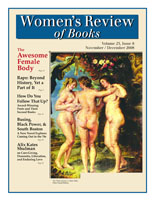
Here is my review from the Nov/Dec WOMEN’S REVIEW OF BOOKS of a biography of Belle da Costa Greene, the African American librarian, rare book expert and art historian who built the collection of the Morgan Library in New York City. The book is, An Illuminated Life: Belle da Costa Greene’s Journey from Prejudice to Privilege, by Heidi Ardizzone.
Playing the Game Square
Belle da Costa Greene had it all and then some. She was beautiful, brilliant, and independent. She was a prodigiously successful international career woman from the early days of the twentieth century until her retirement, amid tributes and honors, in the 1940s. She could pull off both rarified art historical insights and filthy humor in at least four languages. She dined with Fifth Avenue robber barons and partied till dawn with Greenwich Village bohemians. In all of her many circles she was sexual catnip to a bevy of enchanted and enchanting men and women, and thoroughly enjoyed “indoor sports,” as she called her dalliances.
Complex and contradictory, she considered herself a woman of the left, but early on pronounced herself a “masculinist” rather than a feminist. She felt most allied with the type of woman
“…who takes her pleasures as a man does and wearies of them and throws them aside as a man does—who is economically independent and so does not have to earn her living through marriage—who has no morals, but a sense of decency—no scruples outside of playing the game square.”
Although she worked for women’s suffrage—speaking, raising money, and distributing literature—she never joined large public demonstrations. Her ambivalence toward political activism might have had to do with a certain, singular mystery about the very public Miss Greene, who swept through boardrooms, bedrooms, and bank balances like a high fashion bolt of lightening: She was African American.
With the American conversation on race still, for the most part, in the “let’s do lunch . . . someday” stage, academics cannot really be blamed for taking cover behind a wall of jargon when the topic startles them. One jacket blurb extolling this juicy, historically important story of international passion, financial derring-do, the building of great museum collections, and lively family dramas, sells it with the observation that
Heidi Ardizzone challenges the lived experience of “passing” and indeed the whole construct of “passing” in American history. . . . Ardizzone has interrogated historical sources . . . offering us a deep cultural history of the art and literary worlds of New York and Europe at the turn of the century.
Another suggests that a life “so full of contradictions . . . hardly seems possible,” but it does show “the possibilities and dilemmas of modern womanhood.” Right.
Belle da Costa Greene was a daughter of Richard Theodore Greener (1844-1922). A member of the Harvard College class of 1870, Greener was the school’s first known African American graduate. He was a fine student, a young man of wide interests and abilities in history, philosophy, languages ancient and modern, the arts, and political theory. After college, he launched himself into a career of public service, soon adding a law degree from the University of South Carolina Law School to his activist arsenal.
In 1874 Greener married Genevieve Fleet, the accomplished and beautiful daughter of a middle-class, black Washington, DC, family. They had five children in fairly rapid succession; Belle Marion was their third. Greener became widely known and respected as an attorney, educator, speaker, and writer. In 1885, he was appointed secretary to the Grant Monument Association, the committee overseeing the funding and construction of Grant’s Tomb—an indication of his considerable political influence. Former President Chester A. Arthur headed the committee, and J. Pierpont Morgan, who was later to become a significant force in Belle’s life, was its treasurer.
Greener’s nonstop speaking engagements, his extensive travels on behalf of the Republican Party (the party of Lincoln), and his apparent lack of empathy for Genevieve’s struggles on the home front, where she more than once gave birth in his absence, all took a toll on the marriage. She appears to have been blindsided by the nugget of truth in the adage, “You can always tell a Harvard man, but you can’t tell him much.” In 1898, Greener accepted an appointment to a consular post in Vladivostok, Russia, and though it appears that he and his wife never divorced, they never again lived under the same roof.
Genevieve Greener was a very light-skinned woman, and her children ranged in color from cream to olive, although all understood themselves to be African American—at least until, for whatever emotional, financial, or other reasons, Genevieve chose to disassociate the family from her well-known husband by moving herself and her children to the other side of the color line. She changed the family name to Greene, invented a Portuguese grandparent named da Costa to account for that Mediterranean tint, and set up housekeeping in Princeton, New Jersey, a decidedly segregated community.
Belle da Costa Greene loved beautiful books. She determined at an early age to become a librarian and set herself a rigorous preparation. She studied Latin, Greek, modern languages, and European history. After taking a summer course in library studies at Amherst College, she found an entry-level position at the Princeton University Libraries. There, she spent three years in intensive study of early printing, rare books, and historical and illuminated manuscripts. Her knowledge and connoisseurship so impressed her friend and mentor, Junius Morgan, that he recommended her to his uncle, J. Pierpont Morgan, who needed an expert to oversee the growing collection of rare books and artwork that eventually became the Morgan Library.
Greene’s rise was spectacular. She quickly gained Morgan’s trust and admiration, and became his agent in the great race to plunder Europe’s medieval and renaissance treasures and deploy them as evidence of American wealth, ambition, and culture. While other employees quaked in the presence of the imperious Morgan, Greene took him on with feisty humor, and a depth of knowledge and insight into her field that equalled his in the realm of finance. Had they been lovers? she was asked after his death. “No,” she is said to have replied, “We tried.”
One of the handful of top scholars, collectors, and wheeler-dealers of her day in the world of rare, gorgeous, and fabulously valuable books and artworks, she was the only woman among them. Morgan trusted her with millions of dollars. Her goal was to establish a collection that would one day have “neither rival nor equal,” not even the British Museum or the French Bibiotheque Nationale. And in fact, it has long been acknowledged that Greene “transformed a rich man’s casually built collection into one which ranks with the greatest in the world.”
Greene was also celebrated as an outstanding beauty. She was small, willowy, and animated by both an indomitable will and a contagious joie de vivre. The photographs, paintings, and drawings of her gathered here show her to have had an almost chameleon-like quality. By turns sultry, elegant and, with the passage of time, matronly, her skin color is defined by the artists’ handling of light and shadow. Not one to sequester herself in the stacks, Greene enjoyed wearing designer couture, eyebrow-raising jewelry, and extravagant hats. Her quip, “Just because I am a librarian doesn’t mean I have to dress like one” became something of a guild motto for the profession.
Greene’s great love was the pre-eminent authority on renaissance art, Bernard Berenson, the married proprietor of the Villa I Tatti in the hills above Florence (now the Harvard Center for Renaissance Studies). The two met around 1908 and were in and out of each other’s lives and beds, in Europe and the United States, from then until Greene’s death in 1950. Ardizzone’s greatest resource is the trove of hundreds of Greene’s letters to Berenson, archived at I Tatti. In them, we hear her utterly distinctive voice, commenting on the personal seasons and major events of her adult life.
Mary Berenson, Bernard’s wife, herself no paragon of fidelity, viewed Greene with a cold eye—but not simply because of her husband’s infatuation. Mary was Bertrand Russell’s former sister-in-law and a woman used to holding her own in intellectual circles. She had left her first husband for Berenson, and accepted that he was a philanderer. But she had ambitions as an art critic and scholar, and felt as much left out of the conversation as out of her husband’s affections.
This book tells two stories. One is the life and extraordinary career of Belle Da Costa Greene. The other, uneasily embedded within the first, is Ardizzone’s struggle over how to discuss the sticky matter of race in America. She and her publisher seem to have thought they needed to justify this 500-page biography with its subject’s ambiguous racial identity and the extended frisson her act of racial transgression would provide to its readers.
Thus, the first section is rather a slog, a droning narrative of genealogical begats and muddled African American history. Apparently the author assumes that the shockwave she sets off when she establishes Greene’s racial identity will reverberate throughout the narrative, supplying a unifying subtext to all the varied facets of this brilliant, witty, and adventurous woman’s life. In fact the effect is just the opposite; Ardizzione separates out an integral part of a complex person and makes it the defining lens through which we see her. Yet if ever a subject demanded a kaleidoscope rather than a monocle, it was Belle Greene.
A certain naiveté further undercuts this approach. The reader is asked to believe that J. P. Morgan would have given the keys to his collection, an endless series of blank checks, and a role as his international representative to someone whom he had not vetted to a fare-thee-well. Greene’s father—whom, we have seen, Morgan knew—was a dedicated “race man,” and the only passing he ever did was of the bar exam. When he and Morgan served together on the Grant Monument Association, the members had socialized, dined together, and doubtless politely inquired after each other’s families. J. P. Morgan didn’t get rich by being dumb.
So, was Belle daCosta Green passing? Sure, but once she had become indispensable to Morgan, attached to Berenson, and an influential scholar in her own right, she hardly suffered terrors of unmasking. As speculation about her background became a source of spicy gossip, and Morgan’s collecting rival, Isabella Stewart Gardner of New York and Boston, dismissed Greene as a “half-breed who couldn’t help lying,” Greene simply kept her own counsel. She herself could be just as vulgar and apparently careless in her remarks. Finding the lace sleeve of her tea gown torn, she is reported to have glanced at her arm and commented, “The nigger blood shows through, doesn’t it?” Berenson seems to have figured it all out, and given his own travails with the pervasive anti-Semitism of his friends and clients, one hopes he and Greene found support and humor in comparing notes.
In her work, Belle Greene’s passion was for all aspects of the art of the book: text, type, paper, binding, and overall design—the results of scores of choices and decisions from margins to materials to illustrations. She spent decades contemplating the communion of author, editor, illustrator, designer, and reader. While she certainly would relish this biography for its perpetuation of her name, work, and reputation, she would cringe at much that is unfortunate in its execution. This attempt at a crossover work meant to appeal to both academia and the general public is poorly edited and bizarrely repetitious. Still, the story is worthwhile and wonderfully entertaining. Greene lived through two world wars, encountered hundreds of the most interesting, influential, and just plain spectacular personages of her time, and expressed strong, pithy opinions about all of it. Ardizzone’s research is wide ranging and meticulous. She has compiled the information, but it will be up to someone else to tell Greene’s story as it deserves to be told.

We should all support this new and improved incarnation of the original publication, now edited by the brilliant Amy Hoffman. It’s a Massachusetts journal with national and international reach. Be sure you or your institution subscribe.

 VARIETY . SPICE . LIFE