
With the recent passing of Horace Silver, only two of the splendid musicians pictured here are still alive. Do you know who they are?

And Jean Bach’s fine documentary:
http://www.npr.org/templates/story/story.php?storyId=129755810
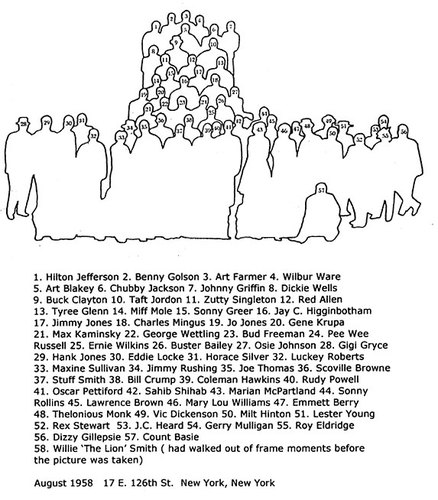
With the recent passing of Horace Silver, only two of the splendid musicians pictured here are still alive. Do you know who they are?
And Jean Bach’s fine documentary:
http://www.npr.org/templates/story/story.php?storyId=129755810

The American middle class is shrinking. More and more people are falling into poverty. College graduates are weighed down by a millstone of debt that shapes their futures in restrictive ways. And we hear, growing louder, a surprising question: Is College Necessary?
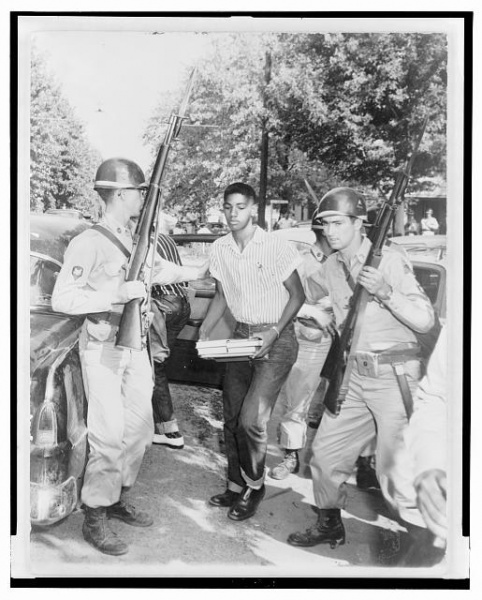
We have our first African American president. Minorities of color are suffering a slower than average recovery from the Great Recession, unskilled jobs have become dead end jobs, and we hear, growing louder, the increasingly familiar question: Is College Necessary? Sixty years after Brown v. Board of Education, is American historical amnesia so pervasive that anyone in this country can actually suggest narrowing educational options?

Why is the question not: How do we reduce the cost of college? College applicants have always been self-selecting, from those for whom it is assumed from the cradle that of course they would attend college, to those who claw their way up from impossibility to possibility.
The full cost of that college education at many private institutions has become prohibitive for all but the most rarified reaches of the one percent. So logic dictates that if you can’t afford it, perhaps you should look for alternatives to higher education. And let’s be clear, this is not about the cost of a college degree, this is about the cost of an education, although young people are increasingly encouraged to restrict their choices to fields of study that rank highest on some salary index, foregoing the possibility of discovering work that is both fulfilling and reasonably well paying.

In fact, logic dictates no such choices. Logic calls for examining the reasons why the cost of higher education rises at an unconscionable rate and finding ways to reverse that process. Logic calls us to ask why private institutions are piling up billions in endowment money and offering 24-hour sushi bars as part of the educational experience. Logic leads to questions about the exorbitant cost of a single textbook, about the all but universal practice of hiring part time, outrageously underpaid, adjunct faculty to teach a majority of undergraduate students.
These eternally junior faculty members receive no job benefits, no job predictability from semester to semester, no increase in pay over the years. They have little say about what they teach, to how many, and on what schedule. They are the highly educated, shamelessly exploited, utterly disillusioned infrastructure of much of American higher education. Many maintain hope of an equitable leg-up in academia long beyond the time such hope is reasonable. And when they give up their chosen vocation and find decent work elsewhere, the next cog is moved in to fill the gap.
But the solution, we are told, is to encourage middle and working class young people to see college as too rich for their blood, as an inevitable commitment to a level of debt that affects everything from their ability to be homeowners to when they will be able to consider retirement. Beware, they are told, that’s not for you. The unspoken admonition is right there: Remember your place.
Posted in African American, Civil Rights, College, Education
Tagged adjunct faculty, black education, College costs, Don't go to college, minority education, the 1%
Now that we have the fascinating story of Dido Belle, let’s take another look at this supposed portrait of Phillis Wheatley in evening dress. 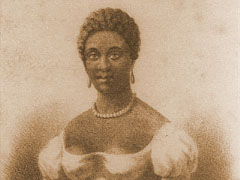 Published in a French review in the 1830s, long after Wheatley’s death, there is virtually no documentation to establish the subject’s identity. I’d say it is far more likely a depiction of Dido Belle.
Detail from double portrait of Elizabeth Murray and her cousin, Dido Elizabeth Belle by an unknown artist (formerly att. Johann Zoffany).
Scotland (1779). Oil on canvas.
Scone Palace, Perth (private collection of the Earl of Mansfield

Engraved portrait of Phillis Wheatley, used as the frontispiece to her collection of poems, Reflections on Various Subjects Religious and Moral (London, 1773). Attributed to the poet and visual artist Scipio Moorhead, a slave in Boston, Massachusetts, and a friend of Phillis Wheatley. One element of the identification of the portrait as Wheatley might have been a mention of the subject’s finger held to her cheek.
— Marilyn Richardson
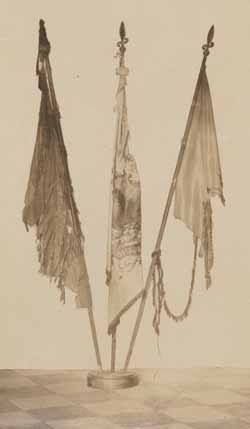
On this day in 1863 the 54th Massachusetts Volunteer Regiment marched through Boston to the waterfront where they shipped off for South Carolina.
[Account of departure is from The Liberator, 5 June 1863. Story about Biddle, who enlisted at age 17, is an unidentified clipping, probably from a Boston newspaper.]



Posted in 19th century, Abolition, African American, Civil War
Tagged 54th Mass. Regiment, Black soldiers, Boston, Civil War
Mother’s Day originated as a call for #peace in the wake of the #CivilWar. Learn more via @ZinnEdProject: http://bit.ly/StHXTI

Mother’s Day Proclamation, 1870
By Julia Ward Howe
Arise, then, women of this day!
Arise, all women who have hearts, Whether our baptism be of water or of tears!
Say firmly: “We will not have great questions decided by irrelevant agencies, Our husbands will not come to us, reeking with carnage, for caresses and applause. Our sons shall not be taken from us to unlearn All that we have been able to teach them of charity, mercy and patience. We, the women of one country, will be too tender of those of another country To allow our sons to be trained to injure theirs.”
From the bosom of the devastated Earth a voice goes up with our own. It says: “Disarm! Disarm! The sword of murder is not the balance of justice.” Blood does not wipe out dishonor, nor violence indicate possession. As men have often forsaken the plough and the anvil at the summons of war, Let women now leave all that may be left of home for a great and earnest day of counsel.
Let them meet first, as women, to bewail and commemorate the dead. Let them solemnly take counsel with each other as to the means Whereby the great human family can live in peace, Each bearing after his own time the sacred impress, not of Caesar, But of God.
In the name of womanhood and humanity, I earnestly ask That a general congress of women without limit of nationality May be appointed and held at someplace deemed most convenient And at the earliest period consistent with its objects, To promote the alliance of the different nationalities, The amicable settlement of international questions,
The great and general interests of peace.
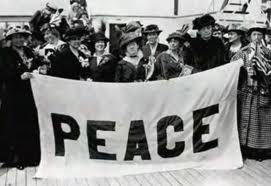

Posted in 1870, 19th century, Julia Ward Howe, Mothers Day, World Peace

Gloria Richardson [not an immediate relative as far as I know] was a major activist in the Civil Rights movement, she led the early 1960s Cambridge Movement in her hometown of Cambridge, Maryland. She turns 92 today. (Photo: Gloria Richardson pushes away a National Guard bayonet, 1963.)
This is one of the bravest gestures in American history. Why is this not an iconic picture? Put this on a stamp. Put it in all the history books about that era.
Or from this angle:




 VARIETY . SPICE . LIFE