
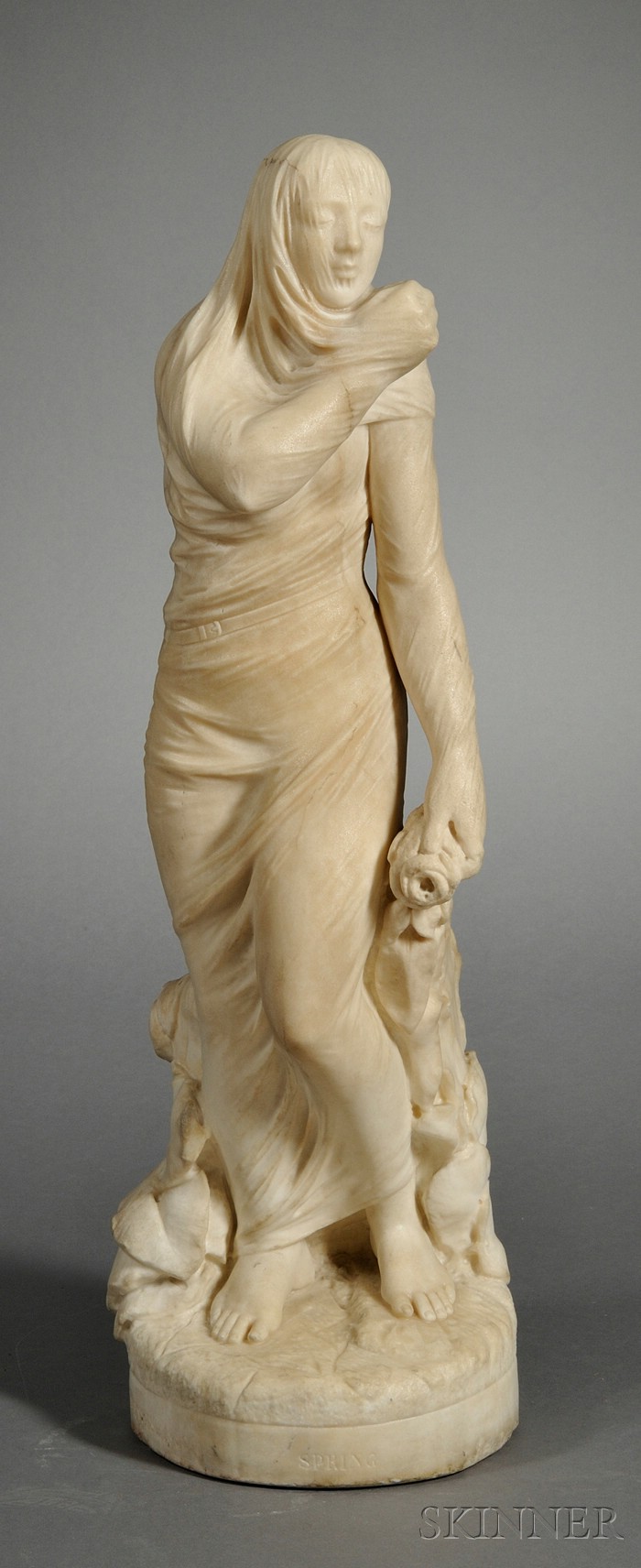
Edmonia Lewis SPRING sold at Skinner, Boston, July 2010
Edmonia Lewis SPRING sold at Skinner, Boston, July 2010
Posted in 19th century, Edmonia Lewis


I have an essay on Edmonia Lewis and her 1865 stay in Florence in this new English language collection by an Italian publisher.

. . .

Posted in Edmonia Lewis, Florence
Edmonia Lewis’s 1874 sculpture, The Marriage of Hiawatha, went for $314,500 at Sotheby’s May 21 American Paintings, Drawings and Sculpture auction. Lot 32. 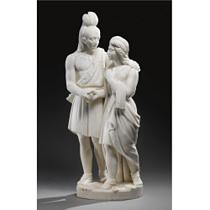
CATALOGUE NOTE
Marilyn Richardson writes: “When Edmonia Lewis left the United States for Europe in 1865, she settled first in Florence and then within the year went on to Rome where she established her life and career as America’s first prominent non-white sculptor. The daughter of a mother of Ojibway Indian descent, her father was a black man from the Caribbean. In Rome she was recognized as a member of the community of expatriate American and British women in the arts that Henry James dubbed the “white, marmorean flock” for the number of sculptors among them. Beginning with her portrait bust of the fallen Brahmin Civil War hero, Robert Gould Shaw, completed in Boston in 1864, Lewis and her work remained in the public eye for most of the latter part of the 19th-century.
Works by Edmonia Lewis showing full-length figures are fewer in number than her portrait busts of contemporary, historical, and literary figures, copies of which were commissioned and sold in greater numbers. This newly recovered example of her group, Hiawatha’s Marriage, (also titled The Marriage of Hiawatha) – – three others from earlier dates are held in private and public collections – – is an instance of her later refinement of the composition.
One of her series of scenes from Henry Wadsworth Longfellow’s poem The Song Of Hiawatha (1855), this sculpture interprets passages presenting Hiawatha as the ” . . . hunter, / From another tribe and country, / Young and tall and very handsome . . .” who had won the heart of the maiden Minnehaha the previous year, but whom she feared might never return. In one of the loveliest sections of his epic poem Longfellow writes of their love in terms approaching an indigenous American prelapsarian Song of Songs.
Lewis’s composition borrows from the classical in a manner her patrons and audience would have readily recognized. Most directly, she echoes groups of Cupid and Psyche, although the couple’s embrace here lacks the traditional erotic charge, replacing passion with a respectful, protective reserve. The beads at Minnehaha’s neck represent their betrothal when “round [her] neck he hung the wampum /As a pledge, the snow-white wampum,” and then, in the scene Lewis depicts, “From the wigwam he departed, / Leading with him Laughing Water; / Hand in hand they went together …” Subsequent verses make it clear that Longfellow considered this journey, with their nights together in the forest, their woodland wedding, referring thereafter to Minnehaha as Hiawatha’s wife.
Lewis, characteristically, has clothed these Native American figures in a combination of animal pelt and elegantly draped fabric, positing both their wilderness origins and their innate finer sensibilities; all with the hint of a Roman toga for Hiawatha and a classically draped garment cascading to Minnehaha’s feet. The crown-like array of feathers atop his forthright brow and guileless face implies Hiawatha’s nobility of character. His elaborate necklace is his most exotic attribute. The rippling waves of Minnehaha’s hair conjure the laughing water of her name. The nicely detailed leather quiver and the array of arrows attached to Hiawatha’s belt speak more of Cupid than of a warrior prince from among the tribes of American Indians fighting for land and survival even as Lewis was at work in her studio on her Indian pieces of the 1860s and ’70s.
Within the composition the lovers lost in each other’s gaze step forward into their new life together but also, as all readers of the most famous American poem of 19th century well knew, they move toward their ultimate doom. Edmonia Lewis placed the work of the sculptor’s hand at the service of the poet’s romance creating the type of compelling narrative in marble embraced by a significant faction of the art-buying public of the day. Replicas of Hiawatha’s Marriage were available for purchase at Lewis’s Roman studio and on trips she took to the United States to exhibit and sell her work. Copies were also displayed at the National Academy of Design in New York City, in 1868, and at the Philadelphia Centennial Exposition in 1876.”
We are grateful to Marilyn Richardson for her assistance in cataloguing this lot.
Posted in 19th century, Edmonia Lewis, Marilyn Richardson
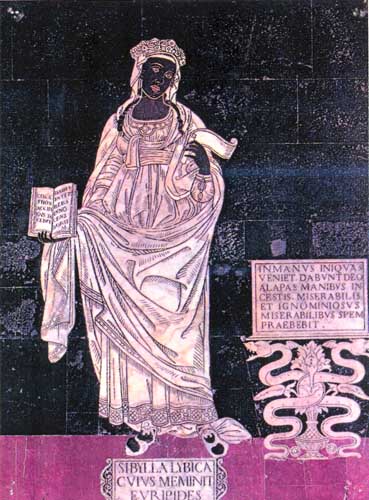
This is a less than ideal image of a wonderful mosaic on the floor of the cathedral at Siena.

and this is Christopher Busta-Peck’s exquisite photo of Lewis’s Hygeia.
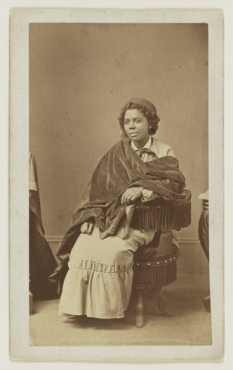
Edmonia Lewis (ca.1842 – after 1911)
Posted in Edmonia Lewis, Lybian Sybil
 Sold at Sotheby’s New York, 22 May 2008
EDMONIA LEWIS
(CIRCA 1843- 1907)
THE OLD ARROW MAKER
Estimate: 70,000—100,000 USD
Lot Sold. Hammer Price with Buyer’s Premium: 301,000 USD
Marilyn Richardson’s letter confirming the sculpture’s authenticity will accompany the lot.
CATALOGUE NOTE
Marilyn Richardson writes: “Along with income from sales and commissions, Edmonia Lewis supported herself through the sale of marble busts and groups illustrating scenes from Henry Wadsworth Longfellow’s phenomenal bestseller, the epic poem The Song of Hiawatha (1855). While inumberable painters and sculptors drew inspiration from that poem, Lewis’s figures were particular favorites among collectors, created as they were by the hand of a woman known to be part Ojibway.
“Copies of The Old Arrow Maker (sometimes called The Old Arrow Maker and His Daughter) identical in design and composition, were also titled The Wooing of Hiawatha. Both titles come from Longfellow’s Chapter X, “Hiawatha’s Wooing,” which includes the passages:
At the doorway of his wigwam
Sat the ancient Arrow-Maker…
Making arrowheads of jasper …
At his side, in all her beauty,
Sat the lovely Minnehaha …
Plaiting mats of flags and rushes; …
And further along:
At the feet of Laughing Water
Hiawatha laid his burden,
Threw the red deer from his shoulders;…
Posted in 19th century, Edmonia Lewis
COWAN’S AUCTION: 2009, Winter Fine and Decorative Art, February 7
Sale Price Including Buyer’s Premium: $52,875.00
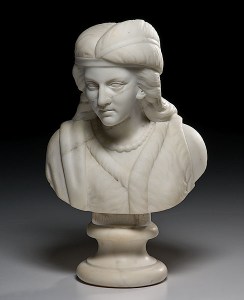
Marble bust atop marble base, standing 11 5/8″ tall. With Minnehaha inscribed between figure and base, and Edmonia Lewis/ Fecit A Roma/ 1868 on reverse side.
Born near Albany, New York, (Mary) Edmonia Lewis (ca. 1842 – after 1909) was the daughter of an Ojibway mother and a black, West Indian, father. Following studies at New York Central College in McGrawville, and at Oberlin College, she arrived in Boston, Massachusetts, in early 1863. There, under the patronage of abolitionists Lydia Maria Child, William Cooper Nell, and William Lloyd Garrison among others, she studied with the sculptor Edward Brackett.
Lewis rented space in the Studio Building in downtown Boston and quickly established herself as an artist on the rise, specializing in plaster and marble portrait busts and medallions. Her reputation was enhanced by the success of her bust of the fallen Brahmin Civil War hero, Robert Gould Shaw. With funds from the sale of copies of that work and of other pieces she sailed for Europe in the summer of 1865. Following a stay in Florence, Lewis settled in Rome where she lived for the rest of her professional life, making frequent trips to the United States to exhibit and sell her work and to garner new commissions.
Lewis’s Roman studio was listed along with those of other major artists of the day in all of the best guidebooks. Her career was followed closely by the American and European press, and she quickly became the first non-white American to gain an international reputation as a sculptor. Along with portrait busts of friends and public figures, her more ambitious early work referenced her dual heritage with themes of black emancipation and of Native American life and lore. In the latter instance she produced a body of work based upon Henry Wadsworth Longfellow’s epic poem, The Song of Hiawatha (1855), the single best-selling poem in the English language of the entire 19th-century. Savvy collectors and curious tourists alike flocked to Lewis’s studio to purchase this work with its added cachet of coming from the hand of an artist who was herself part Indian.
It was not uncommon for sculptors of successful larger works to excerpt a detail of such pieces in the form of a bust sold independently; most notably, Hiram Powers’ Greek Slave was offered in both versions. Given her friendship with Powers, Lewis would have recognized the wisdom of that practice. Her elaborate group, The Old Arrowmaker and His Daughter (also known as The Wooing of Hiawatha), and the standing couple in her Marriage of Hiawatha, provided the models for her busts of Minnehaha and Hiawatha with the subject’s name inscribed on the lower front atop the base. To date there are five known signed and dated copies of Lewis’s Minnehaha bust housed in public and private collections. This previously unknown example adds another to that number.
The mythic love story of Hiawatha and Minnehaha was well known. Still, in depicting the Indian maiden, Lewis walked a cautious line between creating a chaste child of the forest and perpetuating stereotypes of morally naïve savages. While Minnehaha wears an animal pelt, unlike the conventional depictions of such clothing at that period – – often draped over one shoulder with an exposed breast emphasizing a partially clothed life in the wild, hers is fashioned into a modest garment accented with graduated beads at her neck.
Lewis’s characteristic interest in the play of pattern and texture is evident in the pelt bodice framed on one side by the smooth flesh of a bare shoulder, and on the other by the weight and folds of the fabric of the blanket draped across the opposite shoulder. The beads suggest worked stone or bone; the headband is likely a strip of leather. They pose a contrast to the softness of the billowing flow of wavy hair and to the lightness of the elegant sweep and fall of the crowning feather. This is a small work with a considerable aesthetic and narrative burden. Within her persona, Lewis’sMinnehaha is designed to evoke the ambience of an untamed wilderness, the innocence of first love, and the nobility of a tragic figure caught in the inevitability of a sealed fate.
For most of the latter part of the 19th century these small marbles by Edmonia Lewis were highly prized; one example of her bust of Minnehaha was displayed at the National Academy of Design as early as 1868. Beginning in the 1990s they have begun to return to an increasingly avid market.
 We would like to thank Edmonia Lewis scholar Marilyn Richardson for the catalogue essay. She is the Principal of Art + History Consultants, a research and design group in Watertown, MA. The technical description and condition report were provided by Cowan’s Auctions.
Condition: The bust was once painted white, and this residue can still be seen in areas. It has mostly worn to again expose the marble as it would have been after execution. The paint was applied several decades ago. Two natural veins in the marble extend both across the face and the neck/chest, each visible on the reverse side. A small loss is apparent above the Fecit A Romainscription on verso.
(EST $20000-$30000)

and in the same sale:

Posted in 19th century, African American, art, Duncanson, Edmonia Lewis, Marilyn Richardson, women
Tagged 19th century, African American, art, Edmonia Lewis, women

 VARIETY . SPICE . LIFE