Category Archives: 19th century

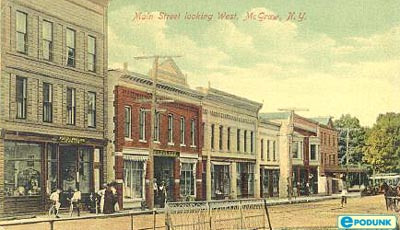
McGraw, New York & New York Central College

Image

McGraw, New York, has a long and rich history. It was the site, in 1849, of the establishment of the trailblazing New York Central College, the first college in the country to enroll students regardless of gender, color, or religious belief, and to employ black and female professors. 

Supporters of the college included Frederick Douglass, Gerritt Smith, and Horace Greely.  Among the many students and professors who went on to distinguish themselves were the sculptor Mary Edmonia Lewis, and Professor Asaph Hall, discoverer of the moons of Mars. The Edmondson sisters, black female students at the school, appear as characters in Harriet Beecher Stowe’s Uncle Tom’s Cabin.  In addition to outstanding and wide-ranging educational opportunities, the college also served as a station on the “underground railroad,”

Whoo-Hoo! Got Quoted in New York Times

You have to read to the part near the bottom about Edmonia Lewis.

http://lnkd.in/Ct3m5e

… ART, BUSTS AND SPHINXES

Lee B. Anderson filled a Manhattan town house with Gothic and Egyptian Revival furniture and Neo-classical statues of politicians and authors. Pinnacles and sphinxes sprouted from chairs, brackets and inkwells, and shelves were packed with busts of Patrick Henry and Washington Irving, among other luminaries.

Mr. Anderson, a retired art education teacher who died in 2010, often pasted labels onto his purchases, identifying makers and likely previous owners.

The collection is now being dispersed. On Sept. 8 and 9, Neal Auction in New Orleans will offer about 1,000 pieces from the estate, and about 1,000 more will appear in a Sept. 19 auction at Doyle New York. (Lots are mostly estimated at a few thousand dollars each in both sales.) More paintings and furniture are slated for Doyle in November and Sotheby’s in New York in January.

For Sept. 19, Doyle has placed a $20,000 to $40,000 estimate on an 1871 white marble relief of a gentleman in profile, sculptured by Edmonia Lewis. Mr. Anderson believed it represented Ralph Waldo Emerson. But Lewis, who had a black father and an Ojibwa mother, might have found Emerson distasteful; he considered nonwhites inferior.

Moreover, she apparently never met Emerson. “We haven’t found any record of a sitting,” said Albert Henderson, a historian who runs a Web site dedicated to the artist,edmonialewis.com, and is publishing an e-book about her.

Lewis had a busy workshop in Rome after the Civil War and often sculptured white activists, including William Lloyd Garrison and Robert Gould Shaw. Marilyn Richardson, an art historian who is writing a Lewis biography for the University of North Carolina Press, said the Doyle carving actually depicted the abolitionist Wendell Phillips.

He had flamboyant sideburns like the strands bristling on the 1871 sculpture. “She really captured him,” Ms. Richardson said in a phone interview.

[The medallion sold for $14,000.]

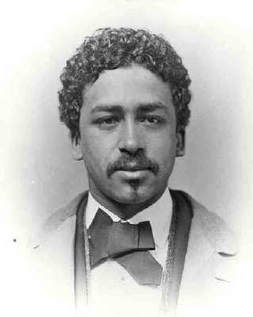
RICHARD GREENER: Remarkable find in Chicago South Side attic – PhotoGallery

Remarkable find in South Side attic – PhotoGallery – Chicago Sun-Times.

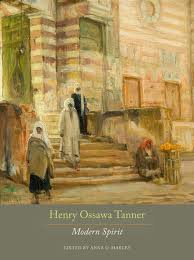
To: New York Times; Re: Henry O. Tanner Exhibition

To The Editor, Re: “An African-American Painter Who Tried to Transcend Race” Feb. 9, 2012)

Ken Johnson’s review of the major Henry O. Tanner retrospective at the Pennsylvania Academy of the Fine Arts is flawed by errors, misinformation, and passages of snide condescension.

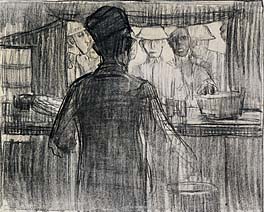
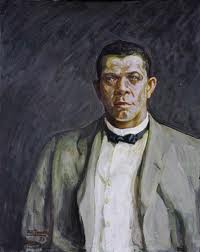
Johnson writes that after 1894 Tanner made no paintings of African- American life. In fact, his formal portrait of Booker T. Washington was completed in 1917. He also made drawings of black servicemen during World War I.

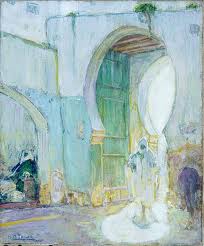
Beyond painting blacks in America, Tanner spent considerable time in North Africa and Egypt producing vivid and complex paintings of architecture, street scenes, and the people of dark and light hue he saw there.

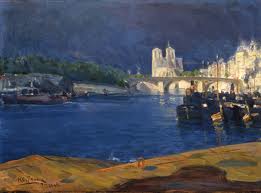
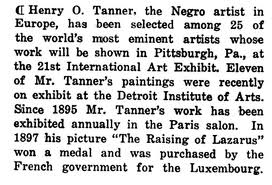
France has long recognized Tanner’s genius with awards and honors; his paintings are in collections at the Louvre, the Musee d’Orsay, and elsewhere.  Along with the religious scenes Mr. Johnson discusses, Tanner painted life in the French countryside and in seaside villages. He produced dozens of gorgeous paintings of Paris that study the play and power of light in scenes observed from dawn to midnight.

Johnson makes much of Tanner’s wish to escape American racism in moving to France, and of the way European critics addressed the work while their American counterparts emphasized the artist’s race. His superficial and dismissive review inclines Mr. Johnson to that outdated American camp. 

I hope the public will take the opportunity to enjoy and judge for itself this once-in-a-lifetime exhibition. So far, the show has attracted a record number of visitors.

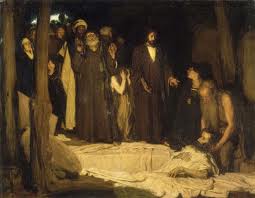
Lazarus

Annunciation

A CHANCE TO MAKE HISTORY: Sarah Remond Plaque Fund

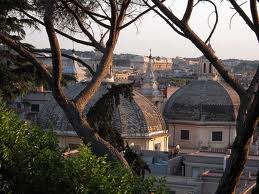
A view of Rome from the Pincio

We continue to raise funds to install a plaque in memory of the extraordinary 19th-century African American activist and physician, Sarah Parker Remond at the Non-Catholic Cemetery in Rome, Italy.

Have a look at the full story and the posts at http://wp.me/P1Hpyy-3Y

Hope you’ll donate and spread the word. Many thanks.

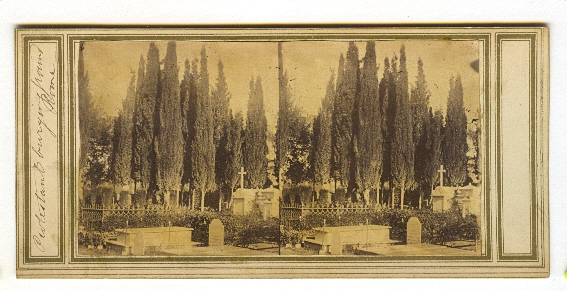
Stereopticon slide of a view of the Non-Catholic Cemetery where Remond is buried.

Thank You & A Request

Sarah Parker Remond Plaque Fund

http://t.co/gAgXsHyb

OUR THANKS to all of you who filled the Salem Athenaeum on Friday for the wonderfully informative and entertaining illustrated talk by Nicholas Stanley-Price. We are grateful for his willingness to give us an evening of his brief visit from Rome to speak about Sarah Parker Remond, members of the Story and Crowninshield families, and others from Salem in Rome’s historic Non-Catholic Cemetery.

We continue to raise  funds to create and install a plaque in the fine location reserved for our memorial to Sarah Parker Remond (1826-1894), African American abolitionist, international lecturer, physician, and social activist, whose final resting place there is unmarked. 

 A total of $10,000 would fund the project, complete with a celebratory unveiling to which all donors will of course be invited, as well as a program in Salem to mark the occasion.

Momentum matters; we hope to complete the project within a year. So please consider donating whatever you can, and be sure to spread the word to others who might like to participate.

All  donors will have their names inscribed in a leather bound volume which will include historical essays on Remond’s life and legacy. One copy will reside in the Roman Cemetery Archives, another in Salem, Massachusetts.

Please send checks payable to:

Remond Plaque Fund, c/o Francis T. Mayo 

265 Essex Street, Suite 301

Salem, MA 01970. 

Thank You!

Marilyn Richardson and Francis Mayo for The Remond Plaque Fund

Sarah Parker Remond and the Remonds of Salem


Sarah Parker Remond was born in Salem, Massachusetts, in 1826. She died in Rome, Italy, in December of 1894. The decades between were filled with a life of activism, adventure, and personal achievement.

She was a daughter of Salem’s most prominent African American family of their day. Yet, when Sarah and one of her sisters finished primary school they were refused admission to the Salem secondary school because of their race.

The Family moved to Newport, Rhode Island, where the children attended a private school. John Remond and others initiated law suits to integrate the Salem school. When their case was won the family returned to Salem.

In 1853 Sarah and a party of friends, including the black historian, William C. Nell, purchased tickets by mail to the most popular opera in Boston, Donizetti’s Don Pasquale, performed at the Howard Athenaeum. When Remond refused to be redirected to the segregated section when the theater managers realized the group was black, she was shoved down a flight of stairs and injured. She sued the theater, winning $500 in damages; the theater was ordered by the court to integrate all seating.

Sarah Parker Remond became a speaker for the American Anti-Slavery Society. She agreed to travel to Great Britain on the eve of the Civil War to promote the cause of the Union and to argue against British sympathies for the Confederate South whose cotton supplied the many British mills. She lectured throughout England, Scotland and Ireland.

 Determined to further her education, she also attended London’s Bedford College For Women. And after the War she went on to attend medical school at Santa Maria Nuova Hospital in Florence, Italy. She lived the remainder of her life in Italy.

Throughout, Remond was an international activist for human rights and women’s suffrage.

Sarah Parker Remond is buried in an unmarked grave at the Non-Catholic Cemetery in Rome. A fund has been established to install a plaque there in her honor. Please have a look at our Donations, Please page and join us in establishing a memorial to this internationally significant 19th-century African American woman.

 Be sure to see the website for the Sarah Parker Remond Plaque Project:

http://t.co/gAgXsHyb

All donors will of course be invited to the unveiling celebration in Rome!

The first shot of the Civil War was fired 150 years ago today

A detail of the Saint-Gaudens memorial to the Mass. 54th Regiment and Col. Robert Gould Shaw, completed in 1897 (remember the film Glory?). It faces the State House on Beacon Hill. Actually this is from a maquette at his studio in Cornish, NH, part of a lovely estate run by the Park Service and def. worth a visit. The Boston monument is one of the most splendid pieces of public art in the country.

Storming Fort Wagner by Allison and Kurz, 1863

————————————————————————–

Currier & Ives, The Bombardment of Fort Sumter

150 years ago, today, the flag pictured above was taken down from Fort Sumter.  146 years ago today, it flew again over that same fort.  On that second occasion, Henry Ward Beecher offered these words:

On this solemn and joyful day, we again lift to the breeze our fathers’ flag, now, again, the banner of the United States, with the fervent prayer that God would crown it with honor, protect it from treason, and send it down to our children…. Terrible in battle, may it be beneficent in peace [and] as long as the sun endures, or the stars, may it wave over a nation neither enslaved nor enslaving…. We lift up our banner, and dedicate it to peace, Union, and liberty, now and forevermore.