Language Matters

Could we possibly call a moratorium among intelligent people on the casual use of Nazi this and Hitler that? (Yes, I know about the soup Nazi; I do not totally lack humor) but I’m sure I’m not the only one who cringes at these refs and name-calling in a political context.

<<<<<<<<<<>>>>>>>>>

Also this exchange about a Boston Globe book review:

BEHOLD MY FATHER

Posted by David Mehegan March 25, 2008 11:57 AM

I have not read Honor Moore’s book, “The Bishop’s Daughter,” about her father, Episcopal bishop Paul Moore, but did read the excerpt in the March 3 New Yorker. She reveals in some detail her father’s lifelong secret (though his family knew) that he had a gay life, in addition to being the married father of several children. On March 17, the magazine published a letter from two of the author’s siblings, deploring her act of outing her father, five years after his death.

“Doesn’t it matter,” wrote Susanna McKean Moore and Paul Moore 3d, “even when someone is dead, that his most fervently held private life, and the unnecessarily explicit details of his marriage, are exposed against his wishes?”

What is the answer to this question? It came up in the case of Anatole Broyard, who kept his African-American family history hidden from the world, even from his children. In that case, Henry Louis Gates Jr. wrote the first story — again, in the New Yorker — but Broyard’s daughter wrote the book (“One Drop”), and it was her story as much as her father’s.

I feel fairly certain that any one of us has things in our pasts, or facts about ourselves, that we might not happily see exposed to the world, even if they aren’t deep dark secrets. If we have chosen to keep them to ourselves, how much time are we allowed, after we die, before someone in our family rips the cover off and says, “Well, Pop, you didn’t want people to know about this, but now you’re dead and my need to tell a story, and be interviewed and go on tour, and earn royalties, is what matters to me”?

If I knew that my father had been ashamed of some things in his own past (and who doesn’t have such things?), chances are I would let them die with him, unless there were some wrong that needed to be righted. Even if he had been a famous man, I like to think that I would not treat his hurts as my raw material, to plunder at will.

After a certain length of time, to be sure, history does take precedence — no one deplores the public knowledge of Franklin Roosevelt’s marital infidelity or physical disability, though they were kept largely hidden in his lifetime. But it is odd, to me at least, that a member of a family would be the one first to turn a bright light on the hidden truth.

There were two responses; mine is the second:

1.

  • After reading the NYer’s excerpt of “The Bishop’s Daughter” by Honor Moore, I was struck, among other things, by the author’s first name. Did she truly “Honor” her father? Of course not. She violated his privacy and trust and exposed his secret life to the world against his and her siblings wishes for her own personal gain. Although I have no first hand knowledge of the author’s motives, I can’t help but think that she is driven by her need to cleanse her feelings of guilt and abandonment. She will have much to answer for if one day she meets him in the afterlife.

  • Posted by Charles Schwab March 28, 08 03:04 PM
  • ———————————–
    2.

  • Whoa! That was then, this is now. Only the most benighted among us would argue that same-sex attractions are shameful; the same goes for folks who would be put off by someone’s so called black blood.I hope you agree that Bishop Moore did nothing inherently wrong – – social mores forced him into the closet. Anatole Broyard’s racial identity was, in some quarters, what you describe as a fact that one “might not happily see exposed to the world.” Did you mean then or now?Your purple prose – – “hidden from the world,” “rip the cover off,” “raw material, to plunder at will” – – lends legitimacy to the idea that being gay or black still carries some stigma. Your innuendo suggests that Honor Moore is some tacky tell-all writer when in fact she’s an established and respected literary figure.Of course, some outings are better than others. When Senator Kerry’s Jewish roots came to light, they, rightfully, lent him a broader cultural context. But Eugene Robinson had to wear a bulletproof vest the day he became an Episcopal bishop. Your readers would welcome clarification of what, in the realms of race, culture, or sexual orientation, you still consider “deep, dark secrets.”Marilyn Richardson
  • Oct 16 Sesquicentennial of John Brown’s Raid on Harper’s Ferry

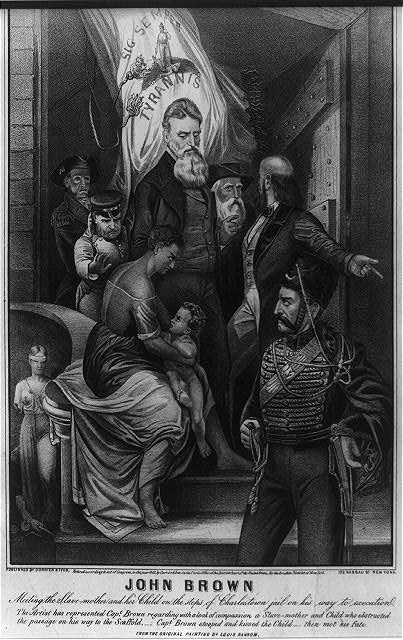
    John Brown
    Brown idealized

    John Brown of Osawatomie spake on his dying day:
    “I will not have to shrive my soul a priest in Slavery’s pay.
    But let some poor slave-mother whom I have striven to free,
    With her children, from the gallows-stair put up a prayer for me!”

    John Brown of Osawatomie, they led him out to die;
    And lo! a poor slave-nother with her little child pressed nigh.
    Then the bold, blue eye grew tender, and the old, harsh face
    grew mild.
    As he stooped between the jeering ranks and kissed the negro’s
    child!

    The shadow of his stormy life that moment fell apart;
    And they who blamed the bloody hand forgave the loving heart.
    And they who blessed the guilty means redeemed the good intent,
    And round the grisly fighter’s hair the martyr’s aureole bent.

    – – Whittier

    This event did not actually happen, Brown was led to the gallows ringed round by soldiers for fear of a rescue attempt.

    Brown burial plaque

    JOHN BROWN OF OSAWATOMIE
    HERE LIES BURIED
    JOHN BROWN
    BORN AT TORRINGTON, CONNECTICUT
    MAY 9TH, 1800
    HE EMIGRATED TO KANSAS IN 1855 WHERE HE TOOK AN
    ACTIVE PART IN THE CONTEST AGAINST THE PRO-SLAVERY PARTY.
    HE GAINED IN AUGUST 1856 A VICTORY AT OSAWATOMIE
    OVER A SUPERIOR NUMBER OF MISSOURIANS WHO HAD
    INVADED KANSAS (WHENCE HIS SURNAME “OSAWATOMIE”)
    HE CONCEIVED THE IDEA OF BECOMING THE LIBERATOR OF
    THE NEGRO SLAVES IN THE SOUTH AND ON THE NIGHT OF
    OCTOBER 16, 1859 AT THE HEAD OF A DEVOTED BAND OF
    22 FOLLOWERS HE SEIZED THE UNITED STATES ARSENAL
    AT HARPER’S FERRY, VIRGINIA WITH THE VIEW OF ARMING
    THE NEGROS WHO MIGHT COME TO HIS FORTIFIED CAMP.
    IN THE FIGHT WITH THE UNITED STATES TROOPS AND CIVILIANS
    WHICH FOLLOWED HE WAS OVERPOWERED AND TAKEN PRISONER
    OCTOBER 18, 1859, HE WAS TRIED BY THE COMMMONWEALTH OF VIRGINIA
    AT CHARLESTOWN, VIRGINIA AND WAS EXECUTED DECEMBER 2, 1859.

    HERE LIE BURIED WITH HIM
    TWELVE OF HIS FOLLOWERS
    WATSON BROWN (SON OF JOHN BROWN) OF NORTH ELBA, N.Y.
    OLIVER BROWN (SON OF JOHN BROWN) OF NORTH ELBA, N.Y.
    WILLIAM THOMPSON, OF NORTH ELBA, N.Y.
    DAUPHIN ADOLPHUS THOMPSON, OF NORTH ELBA, N.Y.
    JOHN HENRI KAGI, ADJUTANT
    WILLIAM H. LEEMAN, LIEUTENANT
    JEREMIAH C. ANDERSON, LIEUTENANT
    STEWARD TAYLOR
    DANGERFIELD NEWBY, NEGRO
    THE ABOVE TEN MEN WERE KILLED AT THE HARPER’S FERRY FIGHT
    AARON D. STEVENS, CAPTAIN
    ALBERT HAZLETT, LIEUTENANT
    THE ABOVE TWO WERE TAKEN PRISONERS AND HANGED MARCH 16, 1860

    On the bottom left:
    THE FOLLOWING MEN OF
    JOHN BROWN’S BAND ESCAPED BUT WERE
    CAPTURED AND HANGED DECEMBER 16, 1859.
    JOHN E. COOK, CAPTAIN
    EDWIN COPPOC, LIEUTENATN
    SHIELDS GREEN, NEGRO
    JOHN A. COPELAND, NEGRO
    On the bottom right:
    THE FOLLOWING MEN OF
    JOHN BROWN’S BAND ESCAPED.
    OWEN BROWN, CAPTAIN (SON OF JOHN BROWN)
    FRANCIS JACKSON MERRIAM
    CHARLES PLUMMER TIDD, CAPTIAN
    BARCLAY COPPOC
    OSBORNE P. ANDERSON, NEGRO
    JOHN ANDERSON, NEGRO

    THIS TABLET ERECTED THROUGH THE EFFORTS OF BYRON R. BREWSTER OF LAKE PLACID, N.Y. 1916
    DESIGNED AND CAST BY JNO. WILLIAMS INC. NEW YORK

    . . . and of course the famous Horace Pippin painting

    “Save your Confederate money boys, the South will rise again”

    HAMMOND, La. (AP) — A Louisiana justice of the peace said he refused to issue a marriage license to an interracial couple out of concern for any children the couple might have.

    Keith Bardwell, justice of the peace in Tangipahoa Parish, says it is his experience that most interracial marriages do not last long.

    Neither Bardwell nor the couple immediately returned phone calls from The Associated Press. But Bardwell told the Daily Star of Hammond that he was not a racist.

    “I do ceremonies for black couples right here in my house,” Bardwell said. “My main concern is for the children.”

    Bardwell said he has discussed the topic with blacks and whites, along with witnessing some interracial marriages. He came to the conclusion that most of black society does not readily accept offspring of such relationships, and neither does white society, he said.

    “I don’t do interracial marriages because I don’t want to put children in a situation they didn’t bring on themselves,” Bardwell said. “In my heart, I feel the children will later suffer.”

    If he does an interracial marriage for one couple, he must do the same for all, he said.

    “I try to treat everyone equally,” he said.

    Thirty-year-old Beth Humphrey and 32-year-old Terence McKay, both of Hammond, say they will consult the U.S. Justice Department about filing a discrimination complaint.

    Humphrey told the newspaper she called Bardwell on Oct. 6 to inquire about getting a marriage license signed. She says Bardwell’s wife told her that Bardwell will not sign marriage licenses for interracial couples.

    “It is really astonishing and disappointing to see this come up in 2009,” said American Civil Liberties Union of Louisiana attorney Katie Schwartzman. “The Supreme Court ruled as far back as 1963 that the government cannot tell people who they can and cannot marry.”

    The ACLU was preparing a letter for the Louisiana Supreme Court, which oversees the state justices of the peace, asking them to investigate Bardwell and see if they can remove him from office, Schwartzman said.

    “He knew he was breaking the law, but continued to do it,” Schwartzman said.

    According to the clerk of court’s office, application for a marriage license must be made three days before the ceremony because there is a 72-hour waiting period. The applicants are asked if they have previously been married. If so, they must show how the marriage ended, such as divorce.

    Other than that, all they need is a birth certificate and Social Security card.

    The license fee is $35, and the license must be signed by a Louisiana minister, justice of the peace or judge. The original is returned to the clerk’s office.

    © 2009 The Associated Press. All rights reserved.

    Song and Poetry

    A fine song; a poem still gathering new verses, and a birthday while on tour . . .

    And a masterpiece:

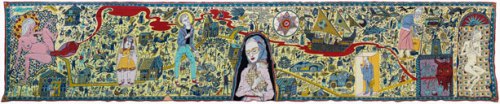
    A Modern Tapestry by Grayson Perry

    top_GP276_TheWalthamstowTap

    promo_IMG_1775 side_IMG_1776

    Retail Therapy?
    By Sarah Douglas
    Published: October 14, 2009

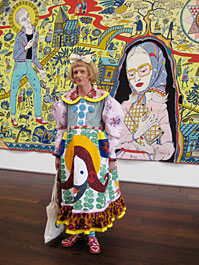
    LONDON—Considering all the talk about recession aesthetics these days, cross-dressing 2003 Turner Prize winner Grayson Perry may have hit a nerve. Perry, resplendent in a colorful, milkmaid-style costume he designed himself (“My Jesus dress,” he called it, and indeed it featured a set of large baby-blue buttons representing the Crucifixion), was on hand at Victoria Miro Gallery yesterday to present his latest effort, the sprawling Walthamstow Tapestry, which pictures the seven stages of man as, in Perry’s words, “one long shopping trip.”

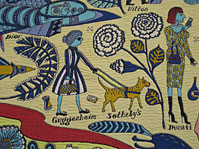
    No sooner are we born, as Perry’s tapestry tells it, than we begin to navigate a forest of brands, from Pampers, KFC, EasyJet, and Volvo to McDonald’s, Disney, Chanel, Rolex, IKEA, Microsoft, Adidas, Nintendo, and many more, represented here as medieval-style personages. Not even art is immune to consumerism: In a trenchant art world send-up, the Guggenheim, a chic figure in sunglasses and a striped frock, is being led by a hound on a leash, labeled Sotheby’s.

    In the summer of 2008, just before the credit crunch, Perry recalled, he was inspired by a set of Sumatran batiks decorated with soldiers to create a sort of Guernica for the Depression. “The Bayeux Tapestry is about the Norman invasion of Britain,” he said. “This is about the invasion of brands into our world. Even without their logos, these names set off a little storm of feelings.”

    This is not to say his tapestry is merely a critique of consumerism. “I wanted to create a desirable object,” he said, noting what he sees as a “category error in the art world” where things like humor and political importance are mistaken for art. The paramount value in visual art is “visual pleasure. Everything is being done better elsewhere,” he noted. “One of my comforts is that life is meaningless,” the artist mused in conclusion. “I’m very proud of this. I hope it ends up in the foyer of a bank. Rumor has it, though, that architect Norman Foster snatched it up. But fret not: A smaller version is available in Miro’s booth at Frieze.

    A fashion tip

    Friend Meg says, want to spiff up your wardrobe this season? Try a new scarf. She especially recommends the one with the rose “tattoo”.

    GetAttachment.aspx

    Visiting Ashley Bryan

    bryan seaglass windowjpg

    ashley-bryan-300x270

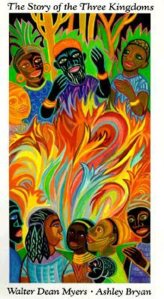
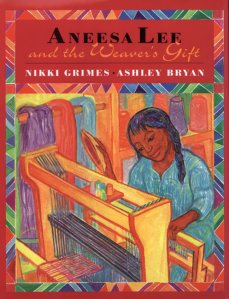
    Made a visit this past weekend to Little Cranberry Island, Maine, to meet the delightful, brilliant, generous and wonderfully prolific artist, Ashley Bryan.  He had his easel set up outside, although it was quite chilly, and was painting the October blossoms in a friend’s garden.

    Bryan flowersjpg

    ashleydownstairs

    Inside, we warmed up with tea and cookies. Later, as we were walking back to the dock to leave, a huge, totally perfect rainbow arched over the island. A breathtaking sight; it was even double for a bit at one end.

    Myers  Bryan
    Grimed Bryanjpg

    le-fou

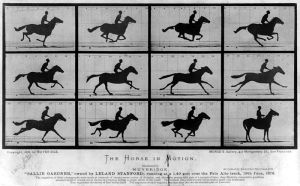
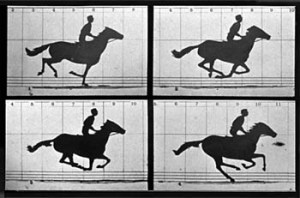
    Eadweard Muybridge, 1878

    Muybridge

    A series of photographs that changed the way human beings see.

    Muybridge 2