OOPS . . .

Just had to share this from the fine posts on  MarioPiperniDotCom:

“How many of these do we not hear about?

Alexios Marakis, a Greek Orthodox priest visiting the U.S., got lost in Tampa and tried to stop and ask directions from Marine reservist Jasen D. Bruce. But instead of offering help, “Bruce struck the priest on the head with a tire iron.” The reservist believed Marakis, who spoke limited English, was an Arab terrorist. Bruce chased the priest for three blocks, “and even called 911 to say that an Arabic man tried to rob him.”

Police arrested Bruce for “aggravated battery with a deadly weapon” and are investigating whether he committed a hate crime.

Yes, it’s a hate crime.”


Goodbye to Brother Blue

brotherblue

Brother Blue and his wife, Ruth Hill

Dr. Hugh Hill,  a spectacular professional storyteller known to one and all as Brother Blue, has died in Cambridge, MA at age 88.

Brother Blue was a true shaman. Once you met and spoke with him, or once you saw and heard him perform, especially out in the open in Harvard Square, or once you were there when he stood to make a comment from the audience at some talk or performance, his image and spirit were forever imprinted upon your own spirit. As he said, he spoke from the middle of the middle of himself, to the middle of the middle of you. The blue butterfly was his symbol and totem.

bluebutterfly

As one writer put it:

“Brother Blue is to story-telling what John Coltrane is to jazz. Walking down the street in Cambridge, people of all ages, sizes, and shapes light up when they see this griot covered in butterflies, bells, balloons, ribbons, and a banner. Underneath the trappings of a roaming town crier and his allegorical tales of the triumphant underdog is a man fueled by a faith in the transformative power of story-telling & service.

The great-grand-son of a slave-owner and his slave, with degrees from Harvard and Yale, Blue rose within the majority-dominated military, ministry, and academia, and emerged as one of the original Afro-American street-hipster-rappers. The official story-teller for Cambridge, Boston, and even the United Nations Habitat Forum, he is often called the “father of modern story-telling,” and devotes most of his unrelenting energy to the public domain — street corners, parks, subways, prisons, hospitals, and classrooms across the urban mosaic.” (Text adapted from Warren Lehrer’s Portrait series.)


blue2350

Cheap Client We’ve All Encountered

An Interview With George Washington

For a few years I was the editor of the Longfellow House Bulletin. For each issue I conducted an interview. Here is my most exceptional interview, by far:

<<<<<<<<<>>>>>>>>>>

AmericanRevolutionGeorgeWashington

In each issue of the Bulletin we include an interview with an individual whose interest in, or whose affiliation with, the Vassall-Craigie-Longfellow House is uniquely important. We are pleased to offer our readers an “interview” with General Washington in his own words at three different intervals during his stay at the Vassall House. We were delighted he gave his candid opinions despite the controversies they might arouse.

September 1775

The Longfellow House Bulletin: In June, shortly before your arrival here in Cambridge, you told the Continental Congress of your hesitation in accepting the appointment as commander-in–chief of  the American forces. What were your thoughts at that time?

General Washington: As I wrote to my wife: so far from seeking this appointment, I have used every endeavor in my power to avoid it, not only from my unwillingness to part with [Martha] and the family, but from a consciousness of it being a trust too great for my capacity…. But it has been a kind of destiny, that has thrown me upon this service, I shall hope that my undertaking it is designed to answer some good purpose. It was utterly out of my power to refuse this appointment without exposing my character to such censures as would have reflected dishonor upon myself and given pain to my friends.

LHB: And what was your opinion of the troops of which you took command?

GW: I found a mixed multitude of people here, under very little discipline, order, or government…. I have already broke one Colonel and five Captains for cowardice and for drawing more pay and provisions than they had men in their companies… in short they are by no means such troops, in any respect, as you are led to believe of them from the accounts which are published, but I need not make myself enemies among them by this declaration, although it is consistent with truth. [There is] an unaccountable kind of stupidity in the lower class of these people which, believe me prevails but too generally among the officers of the Massachusetts part of the Army who are nearly of the same kidney with the Privates, and adds not a little to my difficulties…

LHB: And what was your first assessment of the enemy?

GW: I found the enemy in possession of a place called Bunkers Hill, on Charles Town Neck, strongly entrenched and fortifying themselves. Their force including Marines, Tories, etc. are computed from the best accounts I can get at about 12,000 men. Ours, including sick, absent, etc., at about 16,000.

January 1776

LHB: Mrs. Washington arrived at Vassall House in December when soldier and civilian alike faced another common enemy.

GW: The Small Pox is in every part of Boston…. If we escape [it] in this camp and the country round about, it will be miraculous—Every precaution that can be, is taken to guard against this Evil both by the General Court and myself.

LHB: In the past months there have been great changes in the numbers and the condition of your troops. What strategies did you use to bring about such improvement?

GW: It is easier to conceive than to describe the situation of my mind for some time past, and my feelings under our present circumstances. Search the vast volumes of history through, and I much question whether a case similar to ours is to be found; to wit, to maintain a post against the flower of the British troops for six months together, and at the end of them to have one army disbanded and another to raise within the same distance of a reinforced enemy… [w]hat may be the final issue of the last maneuver, time only can tell. Three things prompt men to a regular discharge of their duty in time of action, Natural bravery—hope of reward —and fear of punishment. The two first are common to the untutored and the disciplined soldier, but the latter most obviously distinguishes the one from the other.

LHB: We hear that Dunmore is encouraging the enlistment of Negro troops.

GW: In December it was represented to me that the free Negroes who have served in this army are very much dissatisfied at being discarded. As it is to be apprehended that they may seek employ in the Ministerial Army, I have presumed to depart from the resolution [of the Continental Congress] respecting them and have given license for their being enlisted. [In August] several Indians of the tribe of St. Francis came here and confirmed the former accounts of the good dispositions of the Indian Nations, and Canadians to the interests of America. A most happy event.

March 1776

LHB: All reports declare the British have fled under the threat of bombardment from the fortifications erected by our troops upon Dorchester Heights in just one night.

GW: The last trump could not have struck them with greater consternation. OnSunday the 17th at 9 o’clock in the forenoon, the ministerial Army evacuated the Town of Boston, and…the forces of the United Colonies are now in actual possession thereof. I have great reason to imagine their flight was precipitated by the appearance of a Work which I had ordered to be thrown up last Saturday night, on an eminence at Dorchester which lay nearest to Boston Neck, called Newkes Hill. The Town, although it has suffered greatly, is not in so bad a state as I expected to find it. The situation in which I found [the enemy’s] works evidently discovered that their retreat was made with the greatest precipitation. They have left their barracks and other works of wood at Bunkers Hill, etc. all standing and have destroyed but a small part of their lines.

LHB: Would you favor us with some of your reflections on these past nine months, sir, as you prepare to leave for Philadelphia?

GW: I believe I may, with great truth affirm, that no man perhaps since the first institution of armies ever commanded one under more difficult circumstances than I have done—to enumerate the particulars would fill a volume—many of my difficulties and distresses were of so peculiar a cast that in order to conceal them from the enemy, I was obliged to conceal them from my friends, indeed from my own army thereby subjecting my conduct to interpretations unfavorable to my character…I am happy however to find, and to hear from different quarters that my reputation stands fair—that my conduct hitherto has given universal satisfaction…

LHB: So to sum up the matter thus far…

GW: It is a great stake we are playing for, and sure we are of winning if the cards are well managed.

Sources: George Washington: Writings, (The Library of America, 1997)

Henry Steele Commanger and Richard B. Morris, eds., The Spirit of Seventy-six: The Story of the American Revolution as told by Participants (New York: Da Capo Press, 1995)

George Washington Papers, at the Library of Congress

Vampire Killing Kit

For Halloween, a bit of  news from KOVELS:

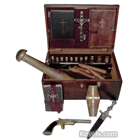
Vampires on TV today are lovable, not dangerous, so there seems to be no need for vampire-killing kits. Killing kits were needed when people were threatened by vampires. Kits have been sold at five or more auctions over the last several years. Each kit was assembled, so the contents varied. Prices ranged from $1,000 on eBay years ago, to $12,000 and $20,300 in 2003, to a claimed $35,000 asking price for a kit eBay wouldn’t allow. Last year a kit in an American walnut case sold for $14,850. It held stakes, mirrors, a gun with silver bullets, crosses, a Bible, holy water, candles, and garlic.

This Saturday, October 31, 2009, another kit will be auctioned. It’s in a rosewood case with mother-of-pearl inlay in the shape of a cross. The required pistol and silver bullets are in a small coffin-shaped case. There are also holy water vials, a prayer book, a cleaver, and a mirror. Wonder how these things protect you from vampires? Hold a mirror in front of a person and if there is no reflection, that person is a vampire. Religious items, garlic, and candle flames scare vampires and chase them away. Silver bullets or a stake through the heart kills vampires. Most vampire kits probably were made after 1897, when the novel “Dracula” was published and made people fear vampires. The kits were made as souvenirs sold at hotels in Europe.

vampire_killing_kit_small

Nice Story About Community Life

October 24, 2009
GREENPOINT JOURNAL
A Place to Worship, and to Jam, Shop and Feast

By RACHEL GRAVES
The mostly empty pews at the Lutheran Church of the Messiah spoke of a dying congregation. But as the 17 worshipers returned to their seats after communion on a recent Sunday, they faced a more encouraging symbol: guitars, keyboards and drums poking up from the choir loft, hinting at the church’s double life.

The instruments belong to two rock bands that, along with many other artists and local food enthusiasts, consider the church in Greenpoint, Brooklyn, a secular home.

“It’s a great reminder of the duality of the space,” said the Rev. Griffin Thomas, pastor of the church, gesturing at the instruments. “The creativity and the art nurtured here make the space more sacred and holy.”

The church will mark its 110th anniversary on Sunday, celebrating its founding as one of the first English-speaking Lutheran churches in New York.

Once bustling with 500 parishioners at Sunday services, the church has seen its congregation wane as the neighborhood has changed.

By the time he took over as pastor in 2004, the church was “like a tomb,” Pastor Thomas said. “Maybe three hours a week the church was being used out of seven days, and the rest of the time it was just sitting here, completely locked up.”

Pastor Thomas thought the lack of activity was bad stewardship of the congregation’s main asset, its building. His favorite part of the church was the choir loft, nestled near the vaulted ceiling and rose-tinted because of a pink, violet and green stained-glass window.

Mr. Thomas cleaned out the loft with the idea that perhaps an artist or writer could work there. He advertised it on Craigslist, calling it a “unique space.” Instead of the quiet artist he was expecting, a rock band responded to his ad.

The members of the band, Penelope, arrived at 129 Russell Street to meet with Pastor Thomas and were stunned to find a century-old brick church decorated for Christmas, complete with a Nativity scene.

“It was like, ‘Say what?’ ” said Allen Wilcox, who plays synthesizers and bass in the band, now reincarnated as Friends Academy. They were intimidated but intrigued by the hallowed space.

Pastor Thomas was worried about noise, but he agreed to let the band rehearse in the church. Friends Academy also brought in another band.

A neighbor did complain about noise, but even that turned into a positive part of the church’s transformation: The neighbor was Brooke O’Harra, a co-founder of the Theater of a Two-Headed Calf. When she learned about the band, she asked if her group could rehearse in the church’s humble green basement. Pastor Thomas eagerly agreed.

Soon, other theater groups were giving performances in the basement, and the pastor was also working with the well-known concert organizer Todd Patrick, or Todd P., to put on rock shows there.

Beyond the arts, the church hosts a community-supported agriculture program, allowing customers to buy directly from local farmers. As they pick out their cherry tomatoes and garlic bulbs, they often hear drumming filtering down from the choir loft.

And the help goes both ways: Instead of renting the space, the groups generally donate part of their proceeds.

For the anniversary celebration on Sunday, the worship service will include Bishop Robert A. Rimbo and many of the artists who use the space.

Members of the congregation have accepted the changes with varying degrees of enthusiasm. Norma Dodenhoff, who has attended the church for 75 years, said she initially found it “overwhelming having all of these strangers coming in,” but now believed it had worked out well.

Asked about the bands, Mrs. Dodenhoff gets a mischievous smile on her face. “The young men are delightful,” she said. “Do I like their music? That’s another story.”

Pastor Thomas said his main concern was respecting the neighborhood and the church. “I obviously don’t want crowd-surfing, mosh-pit, stage-diving kind of people,” he said. “I like to have people who appreciate the space and want it to continue going rather than it being disposable.”

The scene on a recent Saturday night could not have been more different from Sunday services. The church basement was packed with about 250 hipsters eating soup, listening to live music and voting on which of 14 artists’ proposals should receive a grant paid for with participants’ $10 and $20 entrance fees, based on a pay-what-you-can model.

The event, Funding Emerging Art With Sustainable Tactics, or Feast, was started by Jeff Hnilicka, an arts administrator who got to know the church and Pastor Thomas by buying his vegetables there. After a night of barely controlled chaos, Mr. Hnilicka handed a bag of cash — $1,200 — to the winners, Elizabeth Knafo and Dylan Gauthier. Their project, Green My Bodega, plans to connect local farms with bodegas.

The church’s many uses have expanded Pastor Thomas’s pastoral duties considerably: arts impresario, composter, even bouncer, herding beer drinkers who spilled out of the Feast event off the sidewalk. “Not in front of the church,” he told them.

Copyright 2009 The New York Times Company

Crawdaddy Magazine

crawdaddy-history-issue_cov(1)

By an indirect route, I just came upon a mention of an article in Crawdaddy and had a nostalgia smackdown. Vol. 1, No.1, a step up from his Swarthmore mimeos, was published  – – or more accurately, assembled – –  by Paul Williams in my Cambridge, MA, living room, chez Truesdell.

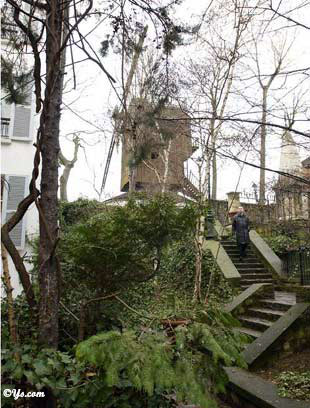
Avenue Junot . . .


moulin montmartre


jean marais

Paris 10:08 upright

Paris.Oct.08.3

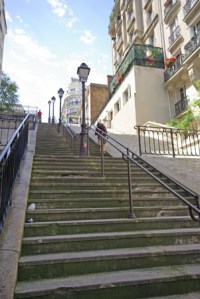
And Montmartre heights

montmartre stairs