Black Man In Elevator

In case you were wondering . . .

Dan Choi’s West Point Ring

How can Obama, of all people, be so slow in ending DADT?

UPDATE:

Dan Choi’s ring was returned on the December 2010 day that President Obama signed the legislation to end Don’t Ask, Don’t Tell. He accepted it back graciously and remarked that he hoped the next time a man gives him a ring it will be as part of their wedding ceremony.

Glenn Beck to Hold Rally in DC on Anniversary of MLK Speech


Photo from Steve M. blog/Fox News

This will be Beck’s I HAVE A SCHEME speech.

What if these people really looked at their motives and told the truth:

1. The international political scene is perilous and reasonably causes great anxiety – – finance and terror included. Beck’s followers want simple answers to complex issues and he promises that, although all he really delivers is double talk.

2. Many of Beck’s followers will never be able to accept a black president as the person in charge, the person who gives orders and makes decisions. It is not a matter only of policies, racial mistrust is a political and visceral issue for most of them.

3. It’s silliness to say this DC gathering is not political. Honor is a fine concept, but it is an abstraction, not something thousands gather to support

4. Any group that emits that much rage is covering their fear, anxiety and sense of weakness. They need someone to be better than, so Beck convinces them that only he and they have “The Truth” and they can look down on everyone who disagrees.

5. Beck is an all-American huckster, making money on the backs of those who have so little. He earns a huge salary from Fox, so why does he have to charge his followers for everything, including this university course scheme? The truth may set you free, but in his plan you certainly will not get your hands on it for free – – and you should buy the over-priced t-shirt and the mug while you’re gaining wisdom.

6. It would be funny if it weren’t at the expense of his fellow Americans that Beck has his followers throwing around words such as Communist, Nazi, Progressive (of all things) with no understanding of what they mean or how they in fact contradict each other.

7. Having people focus on him and his huge ego, Beck turns them away from the pressing issues of the moment where they could be putting their attention and energy. He deliberately closes them off from mainstream news sources so they become less and less informed.

By convincing people that they have the only truth, he cuts off conversation – – let alone debate – – that would allow people to get to know others not like them but who are still good people. This is a classic tactic of a controlling ego.

The billboard below was put up by Iowa Tea Party members, but more rational heads prevailed and it was removed.

How Big Is The BP Oil Spill?

The Size of the Oil Spill

This interactive map lets you compare it to where you live. Pretty amazing.

Oakland Verdict

Oscar Grant was lying face down on the BART subway platform when he was shot point blank in the back by a Transit Officer. There were numerous witnesses and at least seven people videotaped the shooting. Today a jury found that officer guilty of involuntary manslaughter – – 2-4 years sentence.

Sleep well, America.

Mahalia Jackson/ Didn’t It Rain At Newport

From the film, Jazz On A Summer’s Day. I was there. I was a young teenager, and my quite hip and sophisticated mother and I drove down from Massachusetts for two days of the Festival. That day started out bright and lovely, but as is well known, by the time Mahalia took the stage the rain had started. After deciding to continue despite the weather – – the crowd urged her on – – – she cut loose with that fabulous version of “Didn’t It Rain.”

Sistine Brain. Do You Buy It?

In Vatican Fresco, Visions of the Brain

By NICHOLAS BAKALAR

The New York Times

Published: June 21, 2010

It has been hiding in plain sight for the past 500 years, and now two Johns Hopkins professors believe they have found it: one of Michelangelo’s rare anatomical drawings in a panel high on the ceiling of the Sistine Chapel.

Neurosurgery

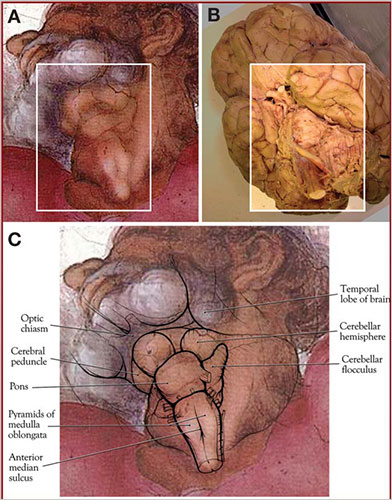
IN PLAIN SIGHT? Two professors believe that Michelangelo hid a drawing of the underside of the brain and the brain stem on the neck and beard of God.

Michelangelo was a conscientious student of human anatomy and enthusiastically dissected corpses throughout his life, but few of his anatomical drawings survive. This one, a depiction of the human brain and brain stem, appears to be drawn on the neck of God, but not all art historians can see it there.

This is not the first picture of a human organ someone has found, or at least imagined, in Michelangelo’s Sistine frescoes. In 1990, in an article in the Journal of the American Medical Association, a physician described what he saw as a rendering of the human brain in the Creation of Adam, the panel showing God touching Adam’s finger. And one physician, a professor of medicine at Baylor University, published an article in a medical journal in 2000 suggesting that Michelangelo had included a drawing of a kidney in another ceiling panel. The author was, perhaps not coincidentally, a kidney specialist.

The latest find, described in a study in the May issue of the journal Neurosurgery, appears directly above the altar in “The Separation of Light From Darkness,” another panel from the series of nine depicting scenes from the Book of Genesis.

God, clothed in flowing red robes, is viewed from below and foreshortened, and seems to be rising into the sky. His arms are raised above his head, and he faces up and to his right, exposing his neck and the underside of a short beard. It is here that the study’s authors, the medical illustrator Ian Suk and Dr. Rafael J. Tamargo, a neurosurgeon, believe that Michelangelo concealed a drawing of the underside of the brain and the brain stem, with parts of the temporal lobe, the medulla, the pons and other structures clearly drawn.

To Dr. Tamargo’s eye, God’s neck in the fresco is distinctly different from those of other figures depicted in more or less the same posture. Usually, the neck looks smooth, but in “The Separation of Light From Darkness” there are lines and shapes quite different from the normal external anatomy of the neck, irregularities that he believes cannot be accidental. “The anatomy of the neck is very, very unusual,” he said, and if it were not intentionally drawn that way, “you would have to postulate that Michelangelo had a very bad day, which is very unlikely because he was very meticulous.”

Is it really there, or are the authors seeing patterns where there are none? The interpretation, Dr. Tamargo said, “is certainly subjective — artists don’t accompany their work with a description of what they’re putting in there. But I think that as with any finding, it’s either validated or rejected by what others think.”

What others think varies considerably. “Suk and Tamargo appear to have done their homework well,” said Gail L. Geiger, a professor of art history at the University of Wisconsin, Madison. “I find the core of their piece quite convincing.”

But Joanna Woods-Marsden, a professor of art history at the University of California, Los Angeles, was outraged as much by the authors’ hypothesis as by their audacity in presenting it. “My initial reaction on looking at the illustrations is that this is complete nonsense, to put it politely,” she wrote in an e-mail message. “To draw arbitrary lines all over Renaissance paintings and expect to be taken seriously by the scholarly community!”

Some details seem to support the authors’ position. God’s beard, usually depicted as long and flowing, appears here short or rolled up to expose the neck. Light provides another hint. The fresco is illuminated from the lower left, but on God’s neck light shines head-on and slightly from the right. The authors insist that Michelangelo, a master of the depiction of light, could only have done this to draw attention to that part of the painting.

Still, some scholars remain dubious. “I think this may be another case of the authors looking too hard for something they want to find,” said Brian A. Curran, an associate professor of art history at Pennsylvania State University. “I don’t want to discourage people from looking. But sometimes a neck is just a neck.”



John and Yoko Riff on Hurston (w/out knowing it)